The Midsize Trio: Cosmos, Earth, and the Adventure Mystery
The centerpiece of the presentation was the introduction of the Lucid Midsize Platform, a modular architecture that will spawn at least three distinct SUVs. First among them is the Lucid Cosmos. Positioned as the performance-oriented urban member of the family, the Cosmos features a sleeker, more aerodynamic profile that clearly draws inspiration from the Air. During the reveal, Lucid designers described it as being for the upscale nurturer—someone who values performance and space but wants a vehicle that feels agile in a city environment.
Following closely is the Lucid Earth. If the Cosmos is the athlete, the Earth is the pragmatist. It carries a more upright, conventional SUV silhouette, looking very much like a distilled version of the larger Gravity. The Earth is intended to be the high-volume leader of the pack, targeting trendsetting families who need the utility of a crossover but refuse to compromise on the efficiency that has become Lucid’s trademark.
The third model remained somewhat shrouded in mystery, referred to only as an adventure-focused SUV. Teaser images revealed a more rugged, squared-off rear end and a higher ground clearance, suggesting that Lucid is ready to follow Rivian into the dirt. This unnamed model will prioritize off-road capability and outdoor utility, likely featuring specialized software modes and durable interior materials.
The Atlas Drive Unit: The Secret to the $50,000 Price Point
The most critical technical achievement announced today wasn’t a body style, but a piece of hardware: the Atlas drive unit. For Lucid to hit a sub-$50,000 price point, it had to rethink its powertrain from the ground up. The Atlas unit is smaller, lighter, and contains 30 percent fewer parts than the Zeus units found in the current Gravity.
Crucially, the Atlas unit features identical housings and mounts for both front and rear applications. This simplification allows Lucid to scale manufacturing dramatically while reducing the bill of materials. According to Chief Engineer Zach Walker, the Atlas system is 40 percent more power-dense than its closest competitors, enabling the midsize vehicles to achieve up to 4.5 miles per kilowatt-hour.
This efficiency allows Lucid to use smaller, lighter battery packs—roughly 69 kilowatt-hours—to achieve a range of approximately 300 miles. By using less battery to go the same distance, Lucid reduces the single most expensive component of the vehicle, providing a buffer for profit margins that have eluded many EV startups.
Lucid Motors To Implement Tiered Monthly Autonomy Subscriptions In 2027
Lucid Motors is transitioning toward a recurring revenue model for its advanced driver assistance systems (ADAS), with monthly subscriptions scheduled to commence in 2027. The program will offer tiered pricing ranging from $69 to $199 per month, depending on the level of autonomous functionality selected by the user. The entry-tier subscription focuses on Level 2+ hands-free highway and city navigation, while higher price points are reserved for Level 3 eyes-off and future Level 4 autonomous stacks. This software-as-a-service strategy utilizes the automaker’s vertical integration and software-defined vehicle architecture to provide a high-margin revenue stream that scales with the vehicle’s operating lifecycle.
Lunar: A Purpose-Built Future for Autonomy
In a move that felt like a direct response to recent industry shifts toward autonomous mobility, Lucid unveiled the Lunar. A purpose-built, two-seat robotaxi concept, the Lunar is a radical departure from traditional automotive design. It features no steering wheel and no pedals. Instead, the cabin is dominated by a massive 36-inch central display and a lounge-like seating arrangement.
The Lunar is more than just a concept; it is the flagship for Lucid’s expanded partnership with Uber. The companies announced a final agreement to deploy Lucid’s midsize vehicles at a scale similar to the Gravity robotaxi program. The Lunar represents the logical conclusion of Lucid’s software-defined vehicle architecture, utilizing the company’s proprietary autonomy stack developed in collaboration with NVIDIA and Nuro.
Capital Efficiency via Dual-Path Autonomy Strategy
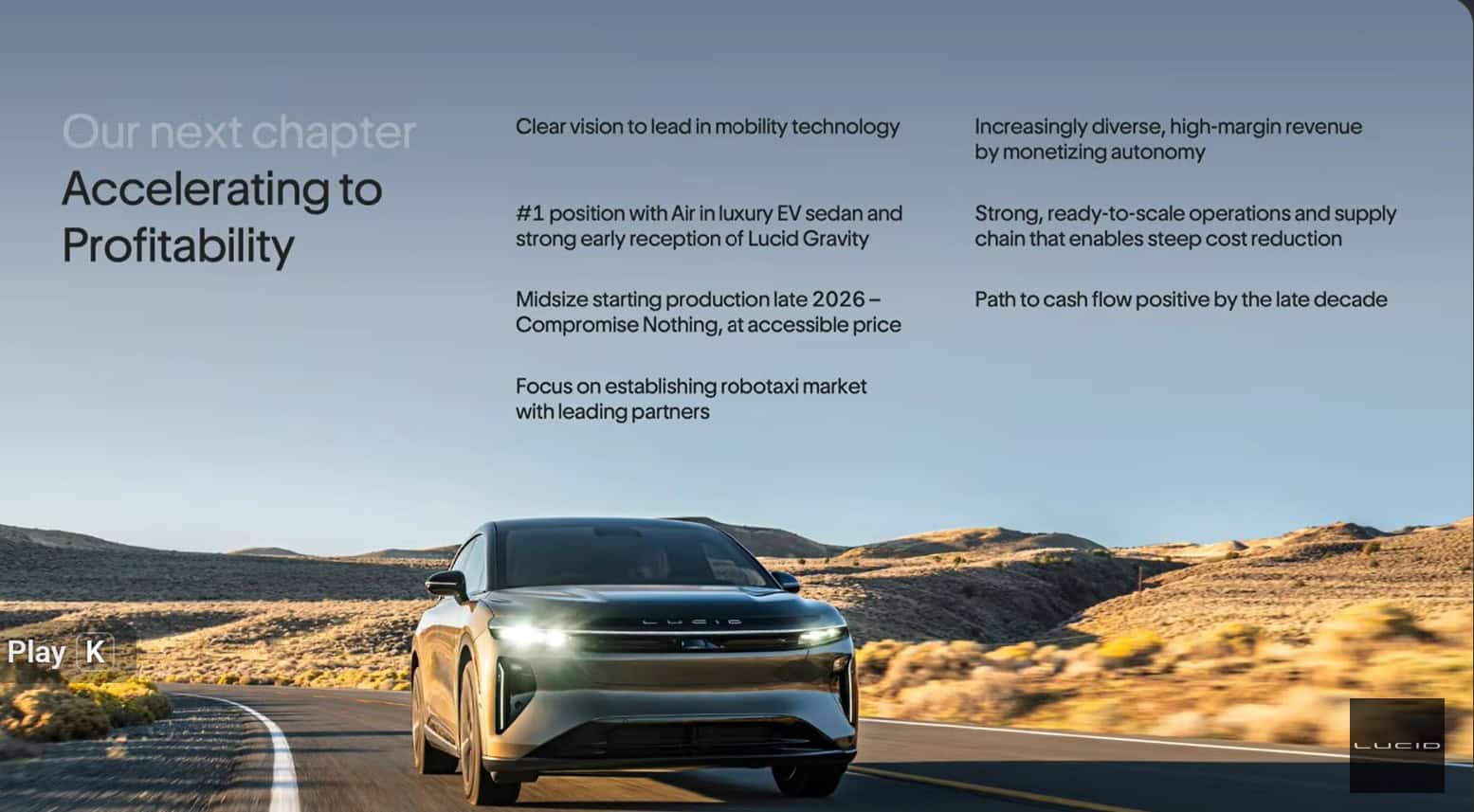
Lucid’s strategic approach to autonomy is predicated on a “dual-path” framework designed to maximize capital efficiency by simultaneously targeting two distinct markets: personally owned vehicles (retail) and autonomous fleet operations (B2B). Interim CEO Marc Winterhoff emphasized that this strategy allows the company to leverage a single, vertically integrated R&D stack across both dimensions. By designing vehicles to be Level 4-ready straight from the factory, Lucid eliminates the high capital expenditure typically associated with retrofitting or re-engineering existing platforms—a process that can cost competitors billions and add years to deployment timelines.
The dual-path model functions as a structural business advantage in the following ways:
-
Retail Path (NVIDIA Partnership): Lucid is integrating the NVIDIA DRIVE AGX Thor platform into its upcoming midsize models. This path generates immediate recurring revenue through a tiered subscription model ($69–$199/month) for consumer-facing Level 2+ and future Level 3/4 “eyes-off” features.
-
Fleet Path (Uber & Nuro Partnership): The B2B path utilizes the same core vehicle architecture for massive-scale deployment, exemplified by the agreement to supply 20,000 autonomy-ready units to the Uber/Nuro robotaxi network. This high-volume commitment provides the necessary scale to drive down hardware and sensor costs for the entire company.
-
Shared Development Costs: Engineering breakthroughs in software-defined vehicle (SDV) architecture, such as the reduction of electronic control units (ECUs) to just three, benefit both paths simultaneously. This prevents the “redundant R&D” traps that have plagued traditional OEMs trying to maintain separate consumer and fleet autonomy divisions.
Through this capital-efficient approach, Lucid expects to maintain a 12-to-18-month time-to-market advantage for new autonomous features while diversifying its revenue streams between high-margin software subscriptions and large-scale commercial fleet contracts.
Radical Efficiency and the Path to Profitability
Interim CEO Marc Winterhoff emphasized a philosophy of radical efficiency throughout the event. This extends beyond the drivetrain into the very assembly of the car. For the midsize platform, Lucid has eliminated traditional beltline moldings on the doors and reduced the number of electronic control units (ECUs) to just three. The wiring harness has been slashed to just 1,100 wires, significantly reducing weight and assembly complexity.
The interior of these new models also showcases a shift in philosophy. While the Air and Gravity featured multi-screen setups, the midsize models will move toward a single, unified display. However, in a move that will surely please traditionalists, Lucid confirmed that mechanical door handles and physical controls for essential functions will remain part of the design.
As the presentation concluded, it was clear that Lucid is no longer just selling a car; it is selling a platform. The company revealed plans to monetize its software stack and even sell its integrated powertrain technology to other OEMs, much like a tech company licensing its OS. For Lynn and the rest of the automotive community, the takeaway is clear: Lucid is betting that engineering excellence can be translated into mass-market success, provided it is delivered with the discipline of a scale-focused manufacturer.
https://www.youtube.com/watch?v=OYEj2KLgOe