By the end of this year’s award season, the nation’s leading automotive safety organization will have demanded more of carmakers than ever before — and, so far, the industry is largely keeping pace.
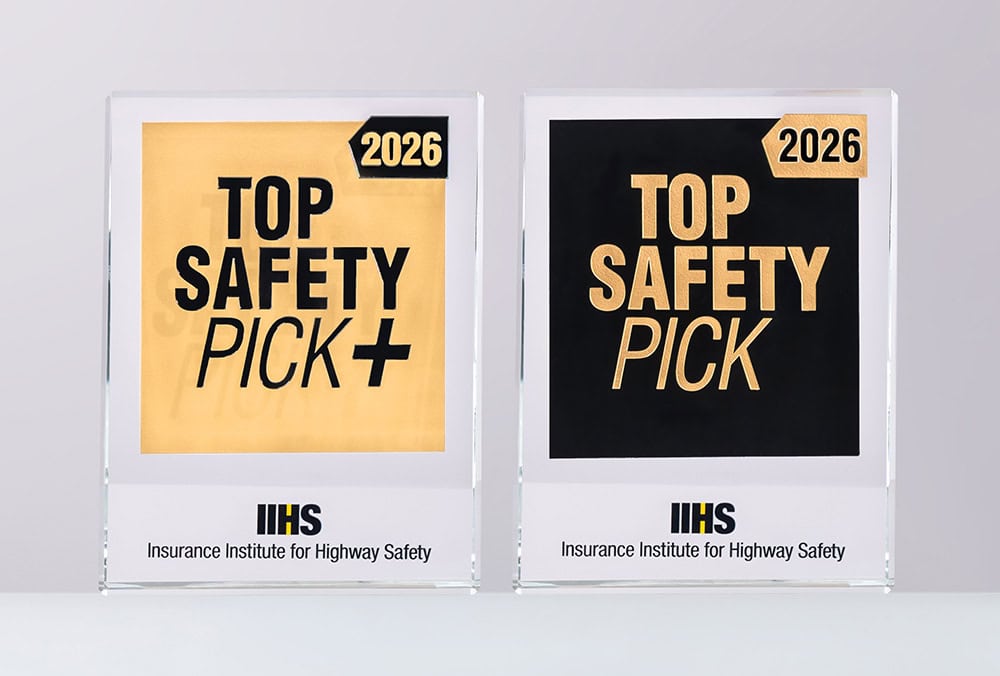
The Insurance Institute for Highway Safety announced that 63 vehicles have qualified for its top safety awards under stricter 2026 criteria, up from 48 at the same point last year. Of those, 45 earned the coveted Top Safety Pick+ designation, while 18 received a Top Safety Pick.
The tougher standards target two longstanding vulnerabilities: the survival odds of passengers riding in the back seat, and the ability of a car’s automated systems to avoid hitting pedestrians and other vehicles at higher speeds.
“This year, we’re asking automakers to make excellent protection for back seat passengers the norm,” said David Harkey, the institute’s president.
For decades, vehicle safety standards focused almost exclusively on front-seat occupants. Beginning in 2022, the institute updated its testing methodology to put greater emphasis on rear-seat protection. This year, for the first time, a top rating in that test is required to qualify for either award — a requirement that has tripped up entire vehicle categories.
No minivans qualified for any award. Minivans, which are marketed overwhelmingly to families with children, have struggled to perform well in the rear-seat test. Only two large pickups made the list: the Tesla Cybertruck and the Toyota Tundra crew cab. No minicars or small pickup trucks qualified at all.
“It’s disappointing that minivans continue to struggle to provide the best-available protection for passengers in the back,” Mr. Harkey said, adding that parents might be better served by some of the sedans and S.U.V.s that did qualify.
S.U.V.s dominated the winners’ list, accounting for 35 of the 45 Top Safety Pick+ winners and 12 of the 18 Top Safety Pick honorees.
Crash Avoidance Takes Center Stage
The most significant shift in this year’s criteria involves a newly required evaluation of a vehicle’s ability to avoid collisions with other cars, motorcycles and large trucks — not just pedestrians — at speeds of up to 43 miles per hour. The test, which was introduced last year but not yet mandatory, examines how well a car’s front crash prevention systems perform in the kinds of high-speed highway encounters that are often the most deadly.
The institute discontinued an older, lower-speed version of the test in 2022. The new evaluation is considerably more demanding, testing performance against a passenger car target, a motorcycle and a semitrailer.
Despite the heightened bar, automakers appear to be adapting quickly. More than 77 percent of 2026 model-year vehicles tested so far have met the new standard, compared with just over 70 percent of 2025 models evaluated last year.
“Stronger structures and better seat belts save lives, but the safest crash is the one that never happens,” Mr. Harkey said.
Winners Span a Wide Price Range
One notable finding: safety need not be a luxury. More than a dozen of the Top Safety Pick+ winners carry a base price below $30,000, and the least expensive of the group — the Kia K4, a compact sedan — starts at just $22,290. The cheapest qualifying small S.U.V. is the Hyundai Kona, at $25,500.
At the other end of the market, all three large S.U.V.s that received Top Safety Pick+ awards — including the Rivian R1S and the Volvo EX90 — cost more than $55,000.
Among the other Top Safety Pick+ winners are the Mazda 3, the Hyundai Sonata, the Toyota Camry and a range of S.U.V.s including the Honda HR-V, the Subaru Forester and the Hyundai Tucson. Several luxury vehicles also qualified, including the BMW X3 and X5, multiple Genesis models and the Audi Q5.
The Top Safety Pick list includes the Honda Accord, the Toyota Prius, the Ford Explorer and the Mercedes-Benz C-Class, among others.
All qualifying vehicles must come with acceptable or better headlights as standard equipment — a requirement that has pushed automakers to improve lighting systems that were once a significant and often overlooked safety gap.
The institute’s 30×30 initiative aims to reduce American crash fatalities by 30 percent before 2030, a goal that officials say requires advances in both vehicle structures and the automated systems increasingly responsible for averting crashes before they occur.
The Insurance Institute for Highway Safety is pushing automakers to improve their crash avoidance systems and demanding superior protection for back seat passengers in the 2026 award season.
Even with tougher rules, 63 vehicles qualify for IIHS awards so far. That is up from 48 at the same point last year. Of the winners, 45 earn a Top Safety Pick+ and 18 earn a Top Safety Pick. Many of these vehicles start below $30,000, showing that strong safety does not have to come with a high price tag.
“This year, we’re asking automakers to make excellent protection for back seat passengers the norm,” IIHS President David Harkey said. “For Top Safety Pick+, we’re requiring crash avoidance systems that are better at preventing pedestrian crashes as well as higher speed crashes with other vehicles.”
The Institute updated its moderate overlap front test in 2022 to emphasize back seat safety. Last year, vehicles needed a good rating in this test to earn TOP SAFETY PICK+ but only an acceptable rating to earn TOP SAFETY PICK. For 2026, a good rating is required for either award.
The crash avoidance requirements for the base award are the same as last year — an acceptable or good rating in the pedestrian front crash prevention test. For Top Safety Pick+, however, vehicles must earn a good rating in that test and an acceptable or good rating in the updated vehicle-to-vehicle front crash prevention evaluation that was introduced last year. In another change, qualifying front crash prevention systems must be standard for either award in 2026.
As before, good ratings in the small overlap front and side tests are required for both awards, and all trims must come with acceptable- or good-rated headlights.
This year’s winners include a variety of models, ranging from small cars to large pickups and from economy cars to luxury vehicles. The manufacturer suggested retail prices for more than a dozen Top Safety Pick+ winners start under $30,000, with the Kia K4 starting at just $22,290.
SUVs of different sizes make up 35 of the 45 total Top Safety Pick+ winners and 12 of the 18 Top Safety Picks. The cheapest small SUV is the Hyundai Kona, which starts at $25,500. While all three large SUVs cost more than $55,000, several midsize SUVs have base prices under $40,000.
No minicars, minivans or small pickups earn awards this year. Only two large pickups qualify: the Tesla Cybertruck and Toyota Tundra crew cab. For many other models in these categories, back seat performance in the moderate overlap test remains a challenge.
“It’s disappointing that minivans continue to struggle to provide the best-available protection for passengers in the back, considering that these are supposed to be family vehicles,” Harkey said. “Based on these results, parents may want to consider some of the more affordable sedans and SUVs that earn awards.”
The biggest change in the award criteria is the addition of the new vehicle-to-vehicle front crash prevention test. The original evaluation, which was discontinued in 2022, focused on rear-end crashes at lower speeds using only a passenger car target. The new evaluation includes test runs at 31, 37 and 43 mph (50, 60 and 70 kilometers per hour). In addition to a passenger car target, it examines performance with a motorcycle target and a semitrailer.
Though the test was not required for an award last year, more than 70% of the 85 model year 2025 vehicles evaluated earned acceptable or good ratings. So far, more than 77% of 2026 models tested meet that standard. These results show that automakers are making fast progress in crash prevention technology.
“Improving crash avoidance is key to achieving our 30×30 vision of reducing U.S. crash deaths by 30% by 2030,” Harkey said. “Stronger structures and better seat belts save lives, but the safest crash is the one that never happens.”
More details about how the vehicle-to-vehicle front crash prevention evaluation and other required tests are conducted can be found in the “About our tests” section of the IIHS website. This resource also includes information about additional tests that are not yet included in the award criteria.
Top Safety Pick +
G Good rating in the small overlap front test
G Good rating in the moderate overlap front test
G Good rating in the side test
AGAcceptable or good headlights (standard availability)
G Good pedestrian front crash prevention (standard availability)
AGAcceptable or good vehicle-to-vehicle front crash prevention 2.0 (standard availability)
Small cars
Kia K4
Mazda 3 hatchback
Mazda 3 sedan
Nissan Sentra
Midsize cars
Hyundai Sonata
Toyota Camry
Midsize luxury car
Audi A5
Large luxury car
2027 Audi A6 Sportback e-tron
Genesis G80 built after June 2025
Small SUVs
Genesis GV60
Honda HR-V
Hyundai Ioniq 5
Hyundai Kona
Hyundai Tucson
Kia Sportage built after May 2025
Mazda CX-30
Mazda CX-50
Subaru Forester
Midsize SUVs
Honda Passport
Hyundai Ioniq 9
Hyundai Santa Fe
Kia EV9
Kia Sorento built after September 2025
Mazda CX-70
Mazda CX-70 PHEV
Mazda CX-90
Mazda CX-90 PHEV
Nissan Murano
Nissan Pathfinder
Subaru Ascent
Subaru Outback
Midsize luxury SUVs
Audi Q5
Audi Q5 Sportback
2027 Audi Q6 e-tron
2027 Audi Q6 Sportback e-tron
BMW X3
BMW X5
Genesis Electrified GV70
Genesis GV70
Genesis GV80
Infiniti QX60
Lexus NX
Large SUVs
Rivian R1S
Volvo EX90
Large pickup
Tesla Cybertruck
Top Safety Pick
G Good rating in the small overlap front test
G Good rating in the moderate overlap front test
G Good rating in the side test
AGAcceptable or good headlights (standard availability)
AGAcceptable or good pedestrian front crash prevention (standard availability)
Small cars
Honda Civic hatchback
Hyundai Elantra
Toyota Prius
Midsize car
Honda Accord
Midsize luxury car
Mercedes-Benz C-Class
Midsize SUVs
Buick Enclave
Ford Explorer
Ford Mustang Mach-E
Volkswagen Atlas
Volkswagen Atlas Cross Sport
Midsize luxury SUVs
Lincoln Nautilus
Mercedes-Benz GLC
Volvo XC90
Volvo XC90 Plug-in Hybrid
Large SUVs
Audi Q7
Infiniti QX80
Nissan Armada
Large pickup
Toyota Tundra crew cab