
For car shoppers who fill out an inquiry form on a dealership website, the experience has improved markedly. More of them hear back quickly, through email, text, and phone. Fewer are ignored entirely. The industry, it would seem, has finally figured out how to return a message.
But the annual study that tracks these behaviors, released this week by Pied Piper, a California-based performance measurement firm, contains a warning beneath the encouraging headline numbers: artificial intelligence is simultaneously raising the floor and concealing the cracks.
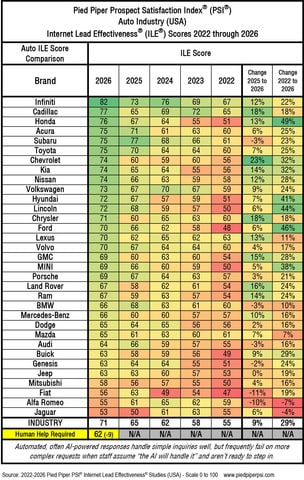
Infiniti dealerships ranked highest in the 2026 Pied Piper PSI Internet Lead Effectiveness study, which is now in its fifteenth year and measured responses to inquiries submitted through 3,290 dealership websites representing every major auto brand. The average Infiniti dealership scored 82 out of 100. The industry as a whole averaged 71, an improvement of six points from last year. Cadillac, Honda, Acura, Subaru, and Toyota followed Infiniti in the rankings.
The gains reflect genuinely changed behavior. Dealerships used text messaging to answer customer questions 54 percent of the time, up from 38 percent the year before. Three-quarters of customers received a phone call, compared to two-thirds in the prior study. And dealers answered questions through multiple channels — email or text plus a phone call — 62 percent of the time, up from 49 percent. Over five years, the share of dealerships providing what the study calls a “perfect response,” meaning fast and through multiple channels, has doubled to 51 percent.
Chevrolet showed the sharpest single-year improvement, gaining 14 points to reach an average score of 74. Of the 33 brands measured, 26 improved and three jumped more than 10 points.
Much of the credit goes to A.I.-powered automation, which has made it easier to send fast, accurate replies to routine inquiries. But Cameron O’Hagan, Pied Piper’s vice president of metrics and analytics, said the technology has introduced a category of failure that traditional dealership software often cannot detect.
“The greatest risk is in the handoffs,” Mr. O’Hagan said, “between systems and from A.I. to dealership staff. Teams assume automation is working and that someone will step in if it fails. Too often, no one does.”
The study identified two distinct breakdown points. The first occurs between the various software systems a dealership relies on — the inventory database, the website, the customer relationship management platform, and the outbound communication tools. Even when a system technically triggers a response, misrouted data or a failed integration can prevent a customer’s actual question from being answered. The second breakdown occurs when A.I. encounters a complex question and hands off to a human employee who may not realize the inquiry is waiting.
The consequences are measurable. When customer inquiries required what the study calls “human help,” dealerships scored nine points lower on average and customers were twice as likely to receive no personal response at all. Dealerships answered typical web inquiries within 24 hours 78 percent of the time, but that figure fell to 51 percent for more complex questions requiring human engagement.
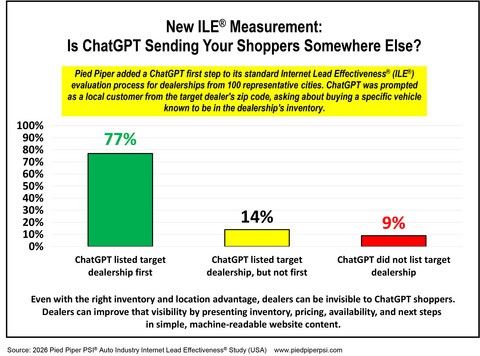
The study also introduced a new measurement this year, examining how dealerships appear when customers use ChatGPT to search for vehicles locally. The results exposed another layer of vulnerability. When ChatGPT was prompted as a local shopper asking about a specific vehicle known to be in inventory, the target dealership appeared first in results 77 percent of the time. In 9 percent of cases, the dealership did not appear at all, even when it had the car in stock and was the nearest option to the shopper.
ChatGPT confirmed that a vehicle was actually in inventory only 70 percent of the time and included a direct link to the specific vehicle listing just 30 percent of the time.
The business case for improving these scores is not abstract. According to Pied Piper’s historical data, individual dealers that move from a score below 40 to above 80 sell 50 percent more vehicles from the same volume of online leads. Currently, 14 percent of dealerships still score below 40, meaning they are failing to personally respond to customers who have already expressed interest in buying a car.
2026 Brand Performance Compared:
- “Answered Question” – How often did the brand’s dealerships email or text an answer to a website customer’s question?
- More than 85% of the time on average: Infiniti, Cadillac, Honda
- Less than 65% of the time on average: Buick, Mitsubishi, Fiat, Jaguar, Alfa Romeo
- “Phoned Customer” – How often did the brand’s dealerships respond by phone to a website customer’s inquiry?
- More than 80% of the time on average: Infiniti, Subaru, Honda, Lincoln, Toyota
- Less than 60% of the time on average: Mazda, Mitsubishi, Alfa Romeo, Genesis, Jaguar
- “Did both” – How often did the brand’s dealerships email or text an answer to a website customer’s question and also phone the customer?
- More than 70% of the time on average: Infiniti, Subaru, MINI
- Less than 45% of the time on average: Genesis, Mitsubishi, Alfa Romeo, Jaguar
- “Did Both Fast” – How often did the brand’s dealerships email or text an answer to a website customer’s question and also phone the customer all within 15 minutes?
- More than 55% of the time on average: Infiniti, Acura, Hyundai
- Less than 35% of the time on average: Genesis, Fiat, Jaguar, Audi
- “Failed to Respond” – How often did the website customer fail to receive a response of any type (email, text, or phone call)?
- Less than 3% of the time on average: Infiniti, Acura, Toyota, Chevrolet
- More than 10% of the time on average: Audi, Mazda, Alfa Romeo, Mitsubishi, Jaguar