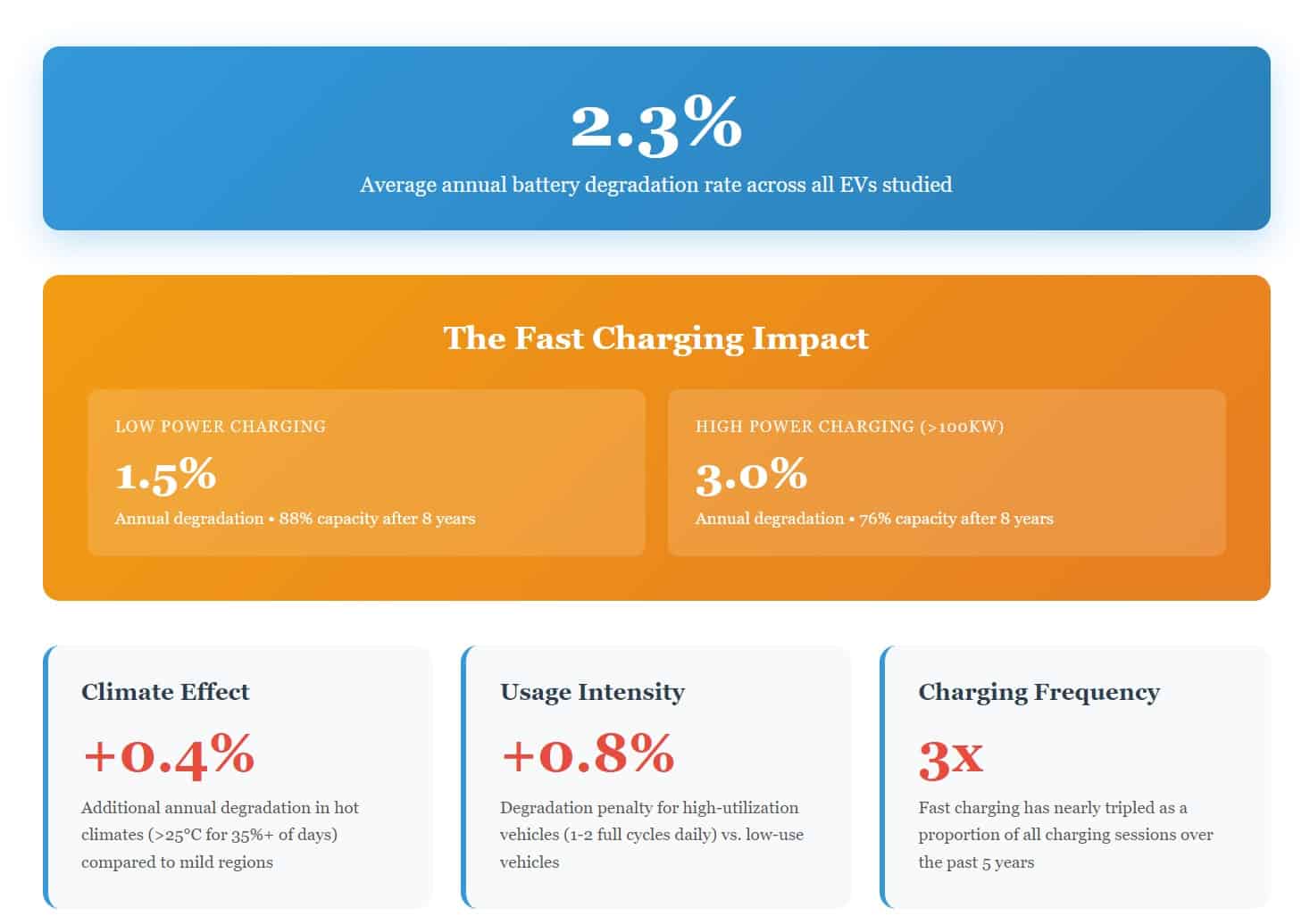
A comprehensive analysis of more than 22,700 electric vehicles conducted by Geotab, a fleet management technology company, reveals that the average EV battery now degrades at a rate of 2.3 percent annually. While that figure might seem modest—suggesting batteries retain about 82 percent of their original capacity after eight years—it represents a subtle shift from just two years ago, when similar studies showed improvement to 1.8 percent annual degradation.
The reversal doesn’t mean batteries are getting worse. Instead, it reflects how we’re using them.
The Fast-Charging Dilemma
Perhaps the most striking finding from the research centers on high-speed charging. As automakers race to deploy ever-more-powerful charging networks—some now exceeding 350 kilowatts—the convenience comes with a hidden cost to battery longevity.
The data shows that vehicles relying heavily on DC fast charging, particularly at power levels above 100 kilowatts, experience degradation rates nearly double those of vehicles charged primarily with slower methods. Cars in the high-frequency, high-power charging category lose capacity at 3.0 percent annually, compared to just 1.5 percent for those using predominantly lower-power options.
“The increase is significant,” said Charlotte Argue, senior manager of sustainable mobility at Geotab. The analysis found that after eight years, a battery subjected to frequent high-power charging would retain approximately 76 percent of its original capacity, while one charged more conservatively would maintain 88 percent.
The distinction matters because charging behavior across Geotab’s customer base has shifted dramatically. The proportion of all charging sessions using DC fast charging has nearly tripled over the past five years, jumping from less than 10 percent to about 25 percent. Meanwhile, the average power delivered during those sessions has climbed from roughly 70 kilowatts to over 90 kilowatts.
The physics behind the degradation are straightforward: High-power charging generates heat and causes rapid chemical reactions inside battery cells, both of which accelerate wear. While battery management systems work to mitigate these effects, they cannot eliminate them entirely.
Geography as Destiny
Climate also plays a measurable role in battery health, though less dramatically than charging behavior. The study found that vehicles operating in hot climates—defined as experiencing temperatures above 25 degrees Celsius more than 35 percent of the time—degraded 0.4 percent faster annually than those in milder regions.
An electric vehicle in Arizona, in other words, will likely see its battery capacity decline more quickly than an identical model driven in Norway. The effect, while modest compared to charging power, underscores how environmental factors remain beyond a driver’s control.
Interestingly, the researchers lacked sufficient data on vehicles operating exclusively in cold climates to isolate the impact of extreme cold on long-term degradation. This gap in understanding reflects the geographic concentration of EV adoption, which has favored temperate and warm regions.
The Myth of the 20-80 Rule
For years, EV owners have been counseled to keep their batteries between 20 and 80 percent charge to minimize stress on the cells. The Geotab analysis suggests this advice, while not entirely wrong, may be unnecessarily restrictive for typical daily use.
The data revealed that moderate exposure to extreme charge levels—either very full or nearly empty—had virtually no impact on degradation rates. Only when vehicles spent more than 80 percent of their total time at these extremes did degradation accelerate significantly, jumping to 2.0 percent annually.
This finding reflects the protective engineering built into modern EV batteries. When your dashboard reads 100 percent, the battery isn’t actually at its absolute chemical maximum; manufacturers build in hidden buffers at both ends of the charge range. Similarly, zero percent doesn’t mean the cells are truly empty.
“The battery is designed to handle normal use across its entire charge range,” the study notes. For most drivers, this means the rigid 20-80 rule is more cautionary than necessary, though vehicles left parked for extended periods at full or near-empty charge should still be avoided.
The Productivity Trade-Off
Perhaps the most nuanced finding involves vehicle utilization. The analysis divided vehicles into usage categories based on how many full charge-discharge cycles they completed daily. High-utilization vehicles—those completing a full cycle every one to two days—showed degradation rates 0.8 percent higher than low-use vehicles cycling every seven days or more.
Yet this accelerated wear may represent a worthwhile trade-off, particularly for commercial fleets. The productivity gains from maximizing vehicle deployment often outweigh the modest penalty in battery life. After eight years, even heavily used vehicles are projected to retain a functional 81.6 percent of capacity.
For fleet managers, this suggests that strategies should prioritize uptime and revenue generation rather than obsessing over battery longevity. The key is ensuring that increased utilization doesn’t also mean increased reliance on high-power charging, which would compound degradation effects.
The Diversity Problem
Beneath these aggregate findings lies substantial variation across vehicle models. The study included 21 different make-models, and degradation rates varied significantly among them. Multi-purpose vehicles, including light vans, averaged 2.7 percent annual degradation, compared to 2.0 percent for passenger cars.
These differences likely stem from variations in battery chemistry and thermal management systems. Some batteries prioritize energy density to maximize driving range, while others emphasize longevity. Lithium iron phosphate batteries, increasingly common in lower-cost EVs, behave differently than nickel manganese cobalt chemistries found in premium vehicles.
The research also noted that many EVs show sharper capacity drops in their first year or two before the rate levels out. The current average of 2.3 percent includes a higher proportion of newer vehicles still in this initial phase. Established models with years of data, by contrast, have stabilized to an impressive 1.4 percent annual degradation.
Strategic Implications
The findings offer clear guidance for both individual owners and fleet operators looking to maximize their investment in electric vehicles. The single most impactful decision within a driver’s control appears to be charging power. Reserving high-speed DC fast charging for genuine emergencies or time-sensitive needs, while relying on slower Level 2 charging for routine use, can dramatically extend battery life.
For commercial fleets, the calculus is more complex. The productivity benefits of quick charging may justify the accelerated degradation, but operators should carefully match charging infrastructure to operational needs rather than defaulting to the highest power available.
The research also validates the long-term viability of electric vehicles. Even under less-than-ideal conditions—frequent fast charging in hot climates—modern EV batteries are projected to retain sufficient capacity to function effectively beyond a typical vehicle’s service life.
As battery technology continues to evolve, with new chemistries and more sophisticated management systems, these degradation rates will likely improve. Solid-state batteries, long promised but not yet commercialized at scale, could fundamentally alter the equation.
For now, the message is one of cautious optimism. Electric vehicle batteries are proving robust and durable, but how we charge them matters more than many drivers realize. In the race to make EVs as convenient as gasoline vehicles, the industry must balance speed with longevity—a tension that will define the next chapter of the electric transition.