U.S. drivers remained more loyal to their car brands in 2025 than at any point in the past five years, even as higher prices and shifting government policies unsettled the auto market, according to a new analysis by LexisNexis Risk Solutions.
The firm’s annual automotive brand loyalty study found that 51.4 percent of American vehicle owners who bought a new car last year stayed with the same brand, a slight increase from 2024 and a signal of surprising stability in a period marked by inflation, rising interest rates and uncertainty around electric-vehicle incentives.
The findings suggest that while many consumers are under financial strain, brand attachment still plays a powerful role in purchase decisions. “Loyalty is reemerging as a critical competitive metric,” said Dave Nemtuda, an associate vice president at LexisNexis Risk Solutions. But he added that performance varied sharply across automakers, with some pulling ahead through stronger hybrid and customer-retention strategies while others lost ground as buyers explored a wider array of electric options.
Toyota emerged as the strongest performer, finishing the year with a loyalty rate of 60.2 percent. Much of that strength came from hybrid owners, whose likelihood of returning to the brand rose to just over 60 percent. Tesla, which had ranked at or near the top of the loyalty charts in recent years, slipped to third place, with 55.9 percent of buyers sticking with the company. As more electric vehicles entered the market, Tesla owners replacing their cars were increasingly willing to consider competitors.
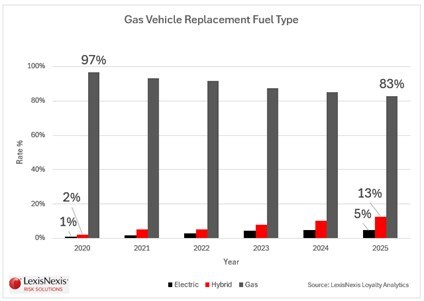
Shifts in fuel preferences also played a growing role in reshaping brand allegiance. While gasoline loyalty rebounded late in the year after federal electric-vehicle tax credits expired, longer-term trends continued to favor alternative powertrains. In 2020, just 3 percent of drivers replacing a gasoline car switched to a hybrid or electric vehicle. By 2025, that figure had climbed to 18 percent, reflecting a gradual but persistent transition away from traditional engines.
Those changes have unfolded against a backdrop of mounting affordability pressures. New vehicle prices passed $50,000 on average last fall, according to Cox Automotive, while incentives fell to 6.7 percent of the typical transaction price. Compact sport-utility vehicles, among the most popular segments, were hit particularly hard by higher tariffs and reduced discounts, adding strain to household budgets.
Even so, loyalty rose in some of the industry’s largest segments. Buyers of large pickup trucks and compact SUVs were more likely to stay with their brands than they had been a year earlier, pushing both categories to their highest loyalty levels in years.
The transition to electric vehicles, however, has been slower and more uneven than many automakers once predicted. Electric-vehicle brand loyalty slipped to 73 percent in 2025, down from 76 percent the year before, as changes in emissions rules and the rollback of incentives left some consumers hesitant to commit. That erosion underscores the challenge manufacturers face in keeping customers as more electric models crowd the market.
With EVs requiring less routine maintenance, the ownership experience is also becoming a more important battleground. Automakers are being forced to find new ways to stay connected to customers after the sale, competing not only on price and technology but on the overall value they deliver over a vehicle’s lifetime.
“Consumers are feeling real pressure from higher prices, lower incentives and shifting federal policy,” said Mike Yakima, a director of vehicle intelligence at LexisNexis Risk Solutions. “The brands that manage to deliver value across the entire ownership journey will be the ones most likely to hold on to their customers as the industry continues to change.”