 J.D. Power released its 2025 U.S. OEM ICE App Report, a study that offers a close look at how owners of internal combustion engine vehicles are engaging with the mobile apps provided by their automakers. The findings suggest that while usage continues to rise, overall satisfaction remains uneven—held back by recurring connectivity problems, sluggish response times and features that, in many cases, do not reflect what owners say they value most.
Nearly 80 percent of ICE vehicle owners report using their manufacturer’s mobile app, a slight increase from last year. Yet the number of drivers who turn to these apps frequently—defined as every time or more than half the time they drive—remains comparatively small at 27 percent. The data show mass-market owners using apps a bit more often than those in premium segments, but both trail far behind electric-vehicle owners, who have consistently shown the highest levels of app engagement across J.D. Power studies.
The report builds on themes seen elsewhere in the firm’s research. In its 2025 Initial Quality Study, app connectivity issues ranked among the top 10 most common industrywide problems. Even with incremental improvements, J.D. Power says that ICE owners continue to encounter slow, unreliable connections that diminish the value and convenience these apps are meant to provide.
“Connectivity and speed continue to be the most significant challenges for ICE vehicle apps,” said Violet Allmandinger, who leads the firm’s mobile apps research. “Owners want apps that work seamlessly every time, with core features that are easy to access and perform reliably. The top performers notably stand out, and this year’s scores reflect that.”
The report also takes a deeper look at which features owners expect to use most often. Daily-use priorities include a built-in garage-door opener (61 percent), smartphone-as-key functionality (39 percent) and the ability to control heated or cooled seats remotely (38 percent). Features such as remote lock and unlock (34 percent) and trunk access (31 percent) see steady interest, while lower-frequency functions like remote park pilot or vehicle order tracking draw far less attention. J.D. Power notes that garage-door integration—despite topping the list—is largely absent from today’s apps, presenting an opening for automakers looking to differentiate their digital offerings.
For the 38 percent of owners who have stopped using their app altogether, the most frequently cited reason is persistent connectivity trouble. Fourteen percent report difficulty navigating unintuitive interfaces, and another 14 percent point to unreliable remote-start performance. Slow responsiveness and inconsistent functionality contribute to further frustration. A smaller share of owners express concerns about missing features, outdated information or challenges managing multiple user accounts.
Owners also provided clearer feedback on accessibility preferences. The majority said that the most essential commands—lock and unlock, garage access and climate control—should appear on the app’s home screen, without requiring additional taps. Functions such as service scheduling and software updates were viewed as important but acceptable if placed slightly deeper in the interface. J.D. Power says this guidance may help automakers streamline their designs without alienating customers who rely on those secondary features.
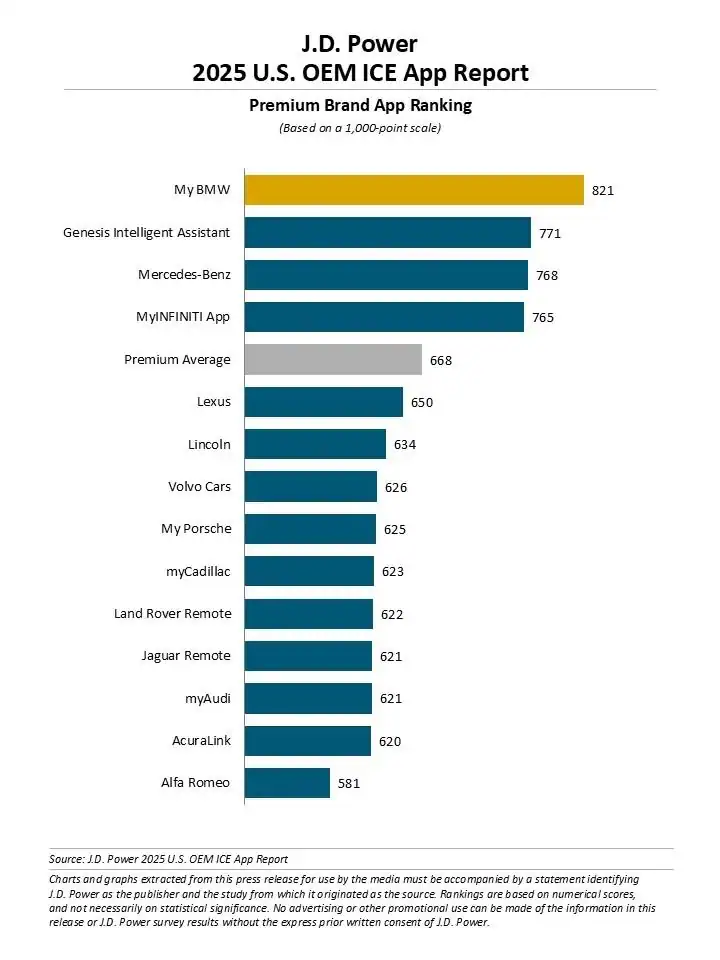
This year’s rankings show a widening gap between leaders and laggards. MINI ranks highest among mass-market brands, followed by Kia Access and MyHyundai with Bluelink. In the premium segment, My BMW leads the field with the highest overall score, while Genesis and Mercedes-Benz round out the top three.
The report draws on surveys conducted with more than 2,100 ICE vehicle owners between September and October 2025. J.D. Power evaluated 32 of the most widely used apps tied to ICE models sold in the United States, applying a framework of more than 300 best practices and 160 feature-specific criteria.