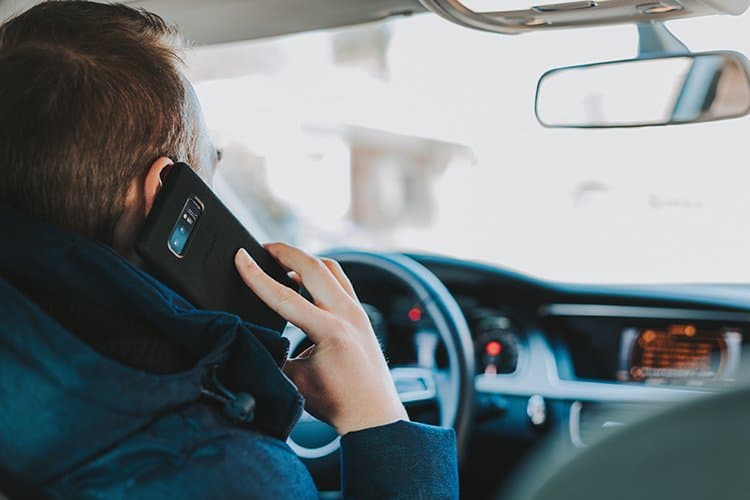
 For years, police crash reports have served as the primary record of what drivers were doing in the moments before a collision. A new study from the Insurance Institute for Highway Safety suggests that record has been badly incomplete. Drawing on telematics data collected through voluntary safe-driving apps, the study finds that cellphone use before crashes is undercounted in police reports by a factor of at least seven.
The findings add a new layer of evidence to a problem safety researchers have long suspected but struggled to quantify: officers arriving at a crash scene have limited ability to see what a driver was doing on a phone seconds before impact, and drivers themselves have little incentive to volunteer that information.
A Gap Hidden in Plain Sight
IIHS President David Harkey said the disconnect between perception and reality has been an open secret in the safety research community. Many smartphone functions leave no visible trace for a witness or investigating officer to observe, and drivers are understandably reluctant to admit they were distracted at the moment of a crash. Telematics, he said, are finally allowing researchers to see the true scope of the issue rather than relying on self-reported or witness-based accounts.
To get there, IIHS researchers worked with Cambridge Mobile Telematics, a company whose platform underpins numerous safe-driving programs, to link nearly 17,000 crashes recorded through its apps to official police reports across four states between 2021 and 2024. Because police reports do not always pinpoint crash times and locations with precision, researchers matched incidents that occurred within the same 15-minute window and within a one-mile radius of each other.
The comparison was stark. Drivers enrolled in CMT-supported programs were using their phones in the 30 seconds before impact in 7 percent of single-vehicle crashes and 8 percent of two-vehicle crashes. Police reports for those same incidents recorded cellphone use in less than 1 percent of cases. Even when researchers narrowed the definition to exclude passive screen activity and focused only on hand-held calls, hands-free calls and physical manipulation of the device, the gap barely closed.
Aimee Cox, the IIHS research scientist who led the study, said the underlying danger has not changed even as the technology has evolved. Any phone use that pulls a driver’s eyes from the road, she said, can raise the risk of a crash, regardless of whether that use fits neatly into older legal categories like texting or talking.
Beyond Texting and Talking
Distraction researchers have long noted that any secondary task, from eating to daydreaming, diverts attention from driving. But tasks that pull a driver’s eyes away from the road carry a distinctly higher risk. IIHS points to research showing that looking away from the road for as little as two seconds doubles the likelihood of a crash or near-crash event.
That risk calculus has shifted as smartphones have evolved well beyond calling and texting. Voice commands have made some of the earliest sources of phone-related distraction, such as dialing a number or dictating a text, comparatively safer. But the same devices now offer a constant stream of new temptations, including games, social media feeds and video apps, many of which demand sustained visual attention rather than a quick glance. Legal frameworks in many states have not kept pace with this shift. To address the broader universe of smartphone distractions, 21 states have moved to prohibit drivers from holding a phone at all, rather than trying to ban specific behaviors like texting. IIHS research indicates these hands-free laws are easier for officers to enforce, since an officer only needs to observe a phone in a driver’s hand rather than determine what the driver was doing with it, and that they are correspondingly more effective at reducing phone-related crashes.
What the Numbers Show
The telematics data, gathered through the CMT platform, tracks hand-held calls, hands-free calls, and physical manipulation of a device, along with instances when a screen was unlocked for something more passive, such as a navigation app or a video. CMT does not typically use that passive-use measure in its own distraction research, but IIHS included it for a fuller comparison against police reports.
Among 15,301 two-vehicle crashes examined, telematics data captured 590 instances of phone manipulation and 534 instances of passive screen use within 30 seconds of impact, alongside 19 hand-held calls and 87 hands-free calls. Police reports for those same crashes recorded only 17 manipulation events, 15 passive-use events, six hand-held calls and a single hands-free call. The pattern held for the 1,543 single-vehicle crashes in the sample, where telematics identified far more manipulation and passive use than officers documented.
Passive use, meaning a driver was not actively touching the phone but had an unlocked screen, appeared almost as often as active manipulation in the moments before impact. Some of that activity likely reflects drivers glancing at turn-by-turn navigation. But the study’s authors note that a separate IIHS survey found nearly a quarter of respondents admitted to watching video on their phone while driving at least once in the previous month. A U.S. Department of Transportation study tracking everyday driving trips found that some of the longest glances drivers took away from the road before crashes and near-crashes were directed at the center stack of the vehicle, a common spot for phone mounts.
Perhaps most striking, the study found that even when both telematics data and police reports flagged cellphone use in the same crash, they rarely agreed on what kind of use it was. Out of nearly 17,000 linked crashes, the two sources matched on the specific type of activity in only three cases.
Why the Disconnect Matters
The researchers acknowledged limits to what the telematics data can show. CMT’s platform does not identify which specific apps a driver was using, and researchers had no way to determine whether phone use actually caused a given crash or whether the phone user was at fault. Nor could they measure how long a driver’s screen stayed unlocked before impact, or account for drivers who may have been using similar apps through CarPlay or Android Auto, systems that do not require an unlocked screen at all.
Even with those caveats, the scale of the mismatch raises questions with real policy consequences. Police officers often lack the tools to determine precisely how a driver was using a phone in the aftermath of a crash, and in many states only specific behaviors, such as texting, are actually illegal. If other forms of phone use that also elevate crash risk go undocumented, lawmakers may be slower to recognize the need for broader restrictions. The study’s authors suggest that telematics data, drawn directly from millions of real-world trips, could eventually help close that gap and give policymakers a clearer picture of where the danger actually lies.