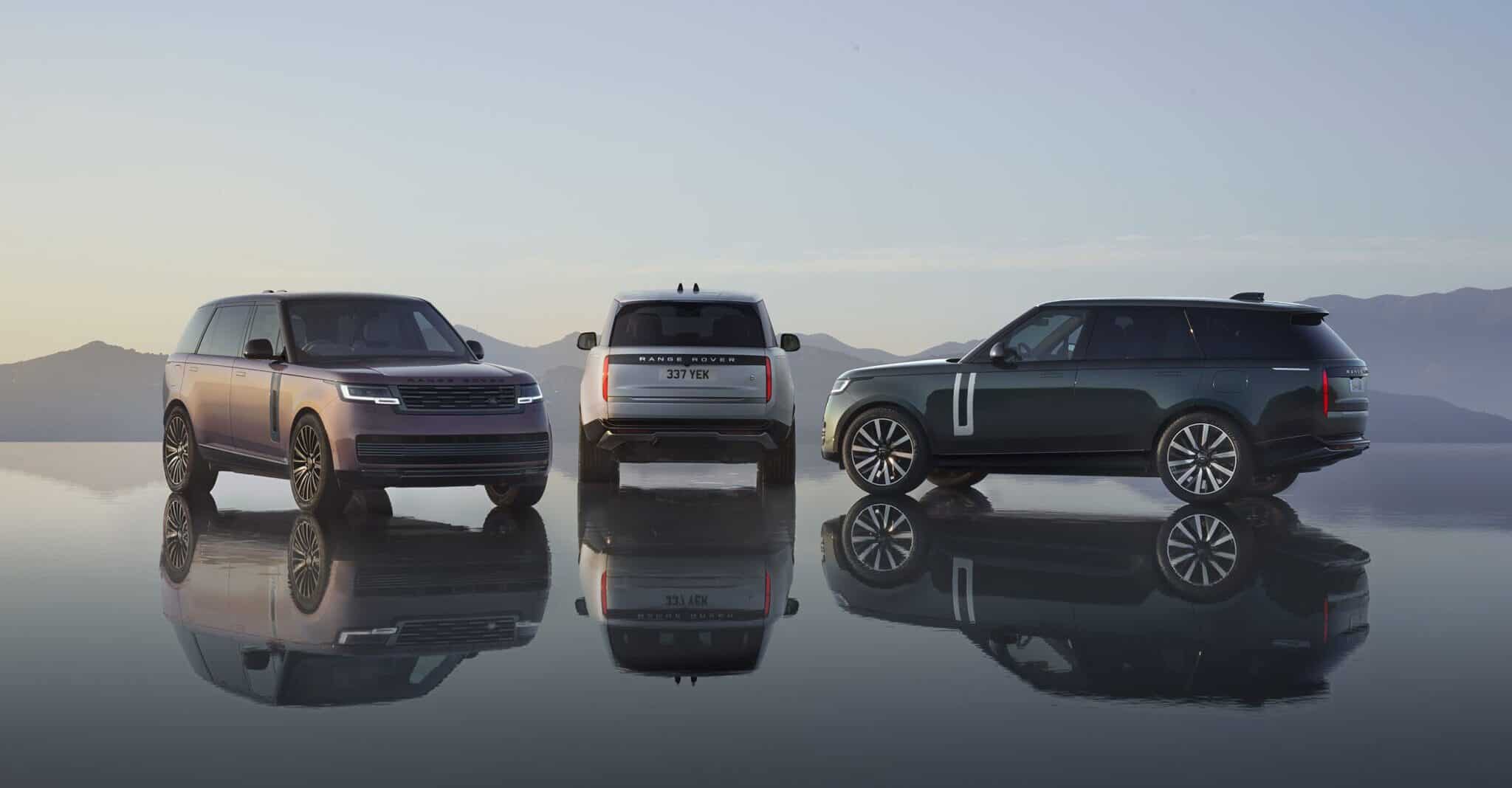
Jaguar Land Rover has introduced the Range Rover Electric, the first battery-electric model in the brand’s 56-year history, closing out a development process that stretched roughly two years longer than originally planned. The result is a vehicle that leans hard on Range Rover’s traditional strengths, off-road capability, driving refinement, and brand identity, while carrying the added engineering complexity of a battery-electric powertrain built largely from scratch.
Range and Charging
The Range Rover Electric offers up to 372 miles of range under UK testing standards, or 333 miles under the more conservative US EPA cycle. Charging from 10 to 80 percent takes roughly 22 minutes, and on a 350 kW DC fast charger the SUV can recover about 125 miles of range in just ten minutes. The vehicle also supports bidirectional charging, allowing it to send power back out to run external devices or, in a home vehicle-to-grid setup, help power a house during an outage.
North American buyers get built-in NACS compatibility, granting direct access to Tesla’s Supercharger network, while JLR’s companion app points UK and European drivers toward more than a million charging points across 29 countries. Plug & Charge functionality, which would let the vehicle authenticate and pay at compatible stations automatically, is expected to arrive in 2027.
### Performance
Twin permanently-excited synchronous motors, one on each axle, combine for 542 to 550 horsepower and up to 850 Nm of torque, more than any Range Rover has produced before, pushing the SUV from zero to 60 mph in 4.3 seconds. For a vehicle this size, that is a genuinely quick number, and it signals that JLR wants the Electric to feel like an evolution of the Range Rover driving character rather than a compromise made in service of a battery pack.
Off-Road Credentials Remain the Brand’s Calling Card
Range Rover has long staked its identity on capability well beyond pavement, and the Electric’s engineering team clearly treated that as non-negotiable. An Integrated Traction Management system adjusts motor speed within 50 milliseconds, about 100 times faster than a comparable combustion-engine system reacting to wheel slip, giving the SUV rapid, granular control when surfaces get unpredictable. A single-pedal off-road mode allows for climbs of up to 45 degrees, and wading depth holds close to 900 mm, keeping the Electric competitive with its ICE stablemates in the terrain department even as it carries a battery pack most off-roaders never have to account for.
Hedging the Bet With Shared Production Lines
Perhaps the most telling decision behind the Range Rover Electric is not in the vehicle itself but in how JLR chose to build it. Rather than standing up dedicated EV-only manufacturing capacity, the automaker is producing the Electric on the same Solihull lines that build its combustion and hybrid Range Rovers, giving JLR the flexibility to shift output toward whichever powertrain proves more popular with buyers. The company has retrained 9,000 workers at the Solihull plant and another 1,500 across the wider West Midlands region to support the new model, while a nearby Wolverhampton facility, expanded over four years to 13 production lines, now manufactures the battery packs and electric drive units.
That shared-line approach reads as a deliberate hedge against a luxury EV market that has proven far less predictable than automakers expected even three or four years ago. By avoiding a dedicated, capital-intensive EV plant, JLR limits its downside if demand for the Electric underwhelms, while preserving the upside if it doesn’t.
A Launch Delayed by Motors, Cyberattacks and Tariffs
The Range Rover Electric arrives roughly two years behind its original schedule, and the reasons for the delay say as much about the state of EV engineering as they do about JLR specifically. The company found that no electric motor available on the market met its internal performance requirements, forcing it to develop a proprietary motor in-house. Partway through development, engineers also switched the front axle from an induction motor to match the rear axle’s permanently-excited synchronous design, a significant late-stage revision. Compounding those technical hurdles, a cyberattack shut down JLR’s production plants for several weeks last year, and rising US tariffs alongside a slump in Chinese demand further complicated the runway to launch.
New Customers, Not Just Converts
JLR reports that more than 80,000 people have already expressed interest in the Range Rover Electric, and 70 percent of them have never owned either a Range Rover or a battery-electric vehicle. That statistic suggests the Electric is functioning as a genuine customer-acquisition tool for the brand rather than simply persuading existing Range Rover owners to switch powertrains. It also suggests that the vehicle’s range and charging specifications, while not best-in-class, are not proving to be a deal-breaker for buyers who are encountering both the brand and the technology for the first time.
The MSRP starts at £154,070 (roughly US$208,500) in the UK.