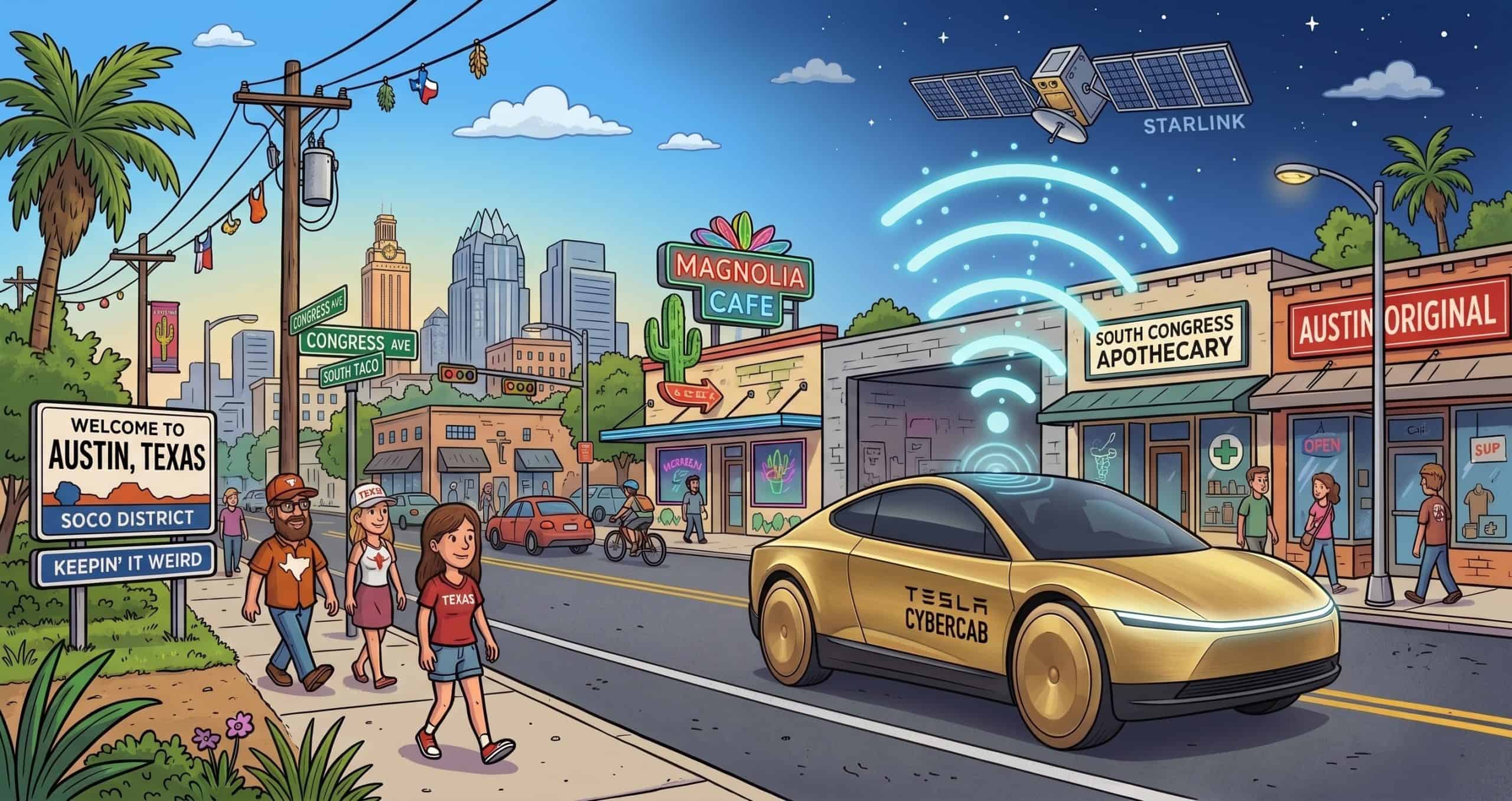
The absence of a broadcast caught much of Tesla’s own online fan base off guard. Posts circulated in the minutes before the event asking where the stream had gone, with one attendee-adjacent account calling it a “PR disaster.” Invited guests, many of them social media influencers who regularly post supportive content about Musk’s companies, had been asked to sign non-disclosure agreements and hold their posts until the event concluded, leaving outside observers to track the moment largely through Tesla’s public robotaxi vehicle tracker rather than any stage presentation.
From Concept Car to Commercial Fleet
The Cybercab has been nearly two years in the making since Musk first unveiled the concept at Warner Bros. Studios in October 2024, promising a low-cost, purpose-built robotaxi that would anchor Tesla’s autonomous ambitions. The production version held to that original vision: a two-seat cabin, butterfly doors, and a complete absence of a steering wheel, accelerator, or brake pedal, with the vehicle relying entirely on Tesla’s Full Self-Driving software and its AI4 computer for every mile.
Production began at Gigafactory Texas earlier this year, and Tesla has spent recent months testing Cybercabs on public roads in multiple cities, occasionally with safety monitors aboard. Ahead of Thursday’s event, the company had registered roughly 45 Cybercabs for commercial operation with Texas regulators, part of a broader fleet of more than 400 autonomous vehicles the state has on record. Sightings of Cybercabs multiplied in the days before the launch, including a cluster of vehicles spotted near Miami International Airport and posts from Musk describing “a storm of Cybercabs” arriving in Austin.
What Tesla Actually Confirmed
Rather than a stage presentation, Tesla’s most concrete announcement came through a quieter channel: an update to its robotaxi website confirming that Cybercab rides were now available in limited areas of Austin through the Robotaxi app. The company did not specify pricing for those rides or clarify how broadly app users could access the new vehicles. Tesla also updated the Robotaxi app itself earlier in the day with expanded support for the Cybercab, including new terms of service that bar riders under age 13, a stricter threshold than the age of eight set for its Model Y robotaxis.
The rollout folds the Cybercab into a ride-hailing network that already operates modified Model Y vehicles, some supervised and some not, across Austin, Dallas, Houston, Miami, Orlando, and Tampa. Analysts had been watching for signals on unit economics, the pace of fleet expansion, and whether Tesla would offer any timeline for selling Cybercabs to individual owners, an idea Musk has floated for years at a target price near twenty-five thousand dollars. None of those questions received a clear public answer Thursday.
A Familiar Playbook, Muted This Time
Thursday’s low-key format echoed the approach Tesla took with its original robotaxi launch in Austin, when the guest list similarly leaned on friendly influencers to control the narrative around a new and closely scrutinized product. Attendee Chuck Cook, one of the invited guests, said Tesla had guests sign a non-disclosure agreement and observe an embargo on posting until after the presentation wrapped. With no stream to watch, pro-Tesla accounts on social media instead refreshed the state’s public tracker of registered autonomous vehicles in Texas, watching the Cybercab count for signs of momentum.
The muted rollout arrives at a sensitive moment for Tesla’s core business. The company’s shares had fallen roughly twenty-one percent for the year heading into Thursday, even as the broader market climbed, though the stock rose more than five percent on the day amid anticipation of the event. Wall Street has increasingly framed the Cybercab, and the broader robotaxi push, as the clearest evidence of whether Tesla can transition from an electric vehicle maker facing intensifying competition, particularly from Chinese automakers, into the artificial intelligence and robotics company Musk has long promised investors it would become.
Regulatory Questions Still Unresolved
Absent from Thursday’s proceedings was any indication that Tesla has secured the regulatory clearances needed for a large-scale, driverless Cybercab deployment. The vehicle’s Full Self-Driving software remains the subject of multiple federal investigations and lawsuits tied to collisions, and Tesla has not detailed whether the Cybercab’s design has cleared federal safety requirements that would normally apply to a vehicle without manual controls. The company’s approach continues to rely on Texas’s relatively permissive framework for autonomous vehicle testing and limited commercial deployment, the same regulatory environment that has allowed its Model Y robotaxi service to expand over the past year.
That regulatory ambiguity drew a direct response from Washington on Thursday. A spokesperson for the National Highway Traffic Safety Administration confirmed to Reuters that the agency is looking into Tesla’s Cybercab rollout, saying only that “NHTSA is in contact with Tesla and is evaluating the situation.” The agency offered no further detail on the scope of its review. The scrutiny centers on a basic design tension: the Cybercab omits a steering wheel, pedals, and mirrors, features that federal safety standards have traditionally assumed every vehicle would have. Whether Tesla’s design meets those standards, or requires a formal exemption, remains an open question the company has yet to address publicly.
For now, the Cybercab’s introduction looks less like the industry-reshaping spectacle Tesla spent weeks teasing and more like an incremental, tightly managed expansion of a ride-hailing service still finding its footing. Whether the muted launch reflects newfound caution, unresolved regulatory hurdles, or simply a shift in how Tesla chooses to manage its messaging may become clearer in the days ahead, particularly if the company follows through on hints of additional announcements over what one Tesla executive called “an exciting 48 hours.”