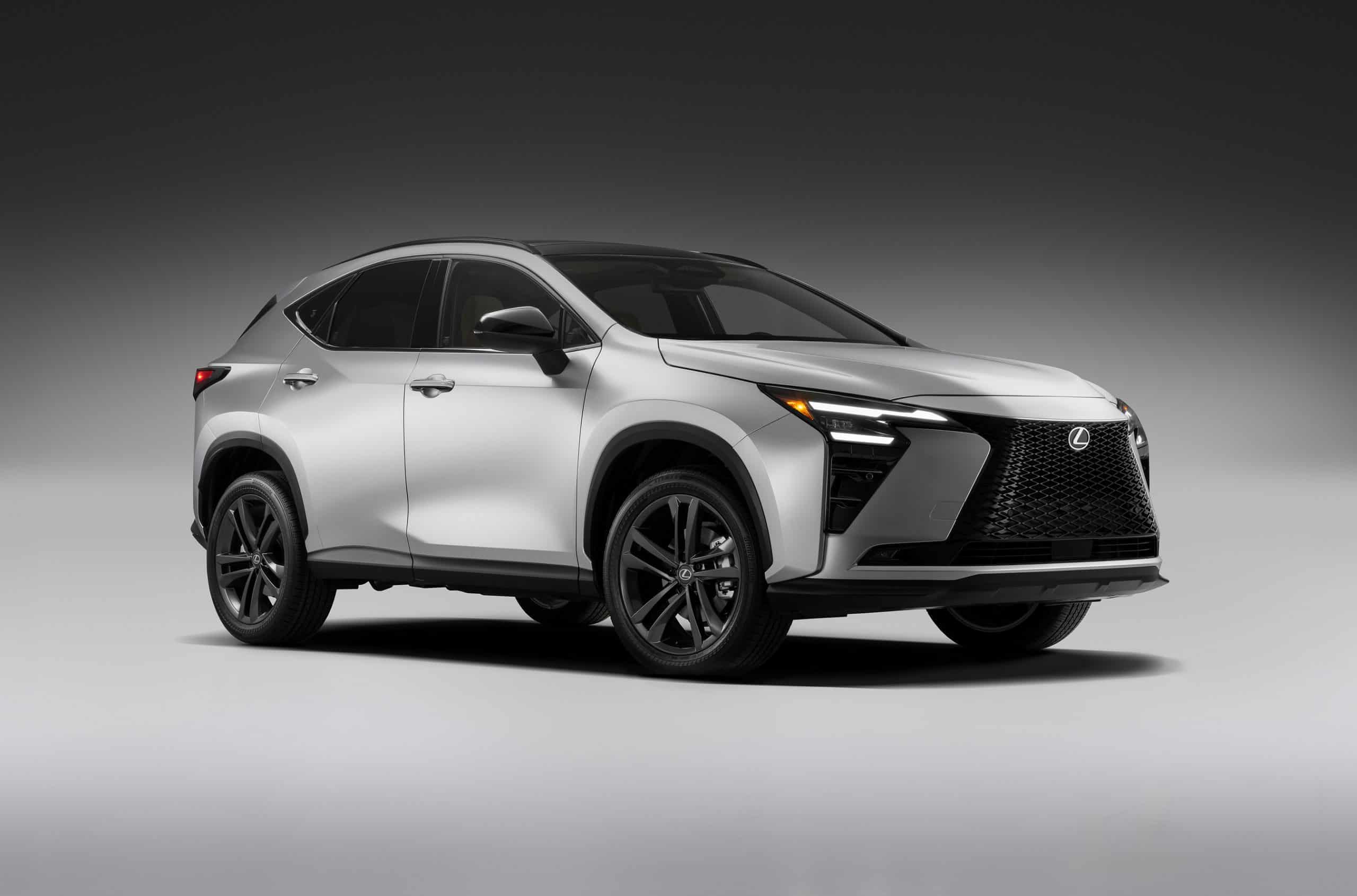
The move places the NX fully in line with Lexus’s broader strategy of pairing traditional hybrid technology with plug-in options rather than leaping straight to a battery-electric-only lineup, at least for this segment. Buyers will choose between a standard hybrid electric vehicle, badged 350h, and a plug-in hybrid, badged 450h+, across four trim levels: Premium, Premium+, F Sport and Luxury.
A Battery Built for Real-World Range
The headline change sits under the floor of the plug-in model. Lexus says the 450h+ now uses a newly developed lithium-ion battery pack delivering an 8 percent increase in output and a 30 percent jump in capacity compared with the outgoing generation, with an estimated range of more than 40 miles on electricity alone for select grades, according to the automaker. That figure comes from Lexus’s own testing; official EPA ratings will follow closer to the vehicle’s on-sale date.
Engineers also changed how the battery physically sits in the car, shifting the cell layout from a longitudinal to a transverse arrangement. Lexus says this increases lateral rigidity across the body while lowering the vehicle’s center of gravity, a detail that speaks to how much of this redesign is really about handling rather than just electric range. Plug-in models now come standard with DC fast charging and a powered charge port door, addressing what had been a notable gap for owners who wanted quicker top-ups away from home.
Compact Motors, Silicon Carbide Electronics
Both powertrains benefit from a new e-Axle assembly that integrates the transaxle, motor and power control unit into a single, more compact package. Lexus attributes part of the efficiency gain to the adoption of silicon carbide semiconductors in the inverter, a technology increasingly common across the industry for squeezing more range and responsiveness out of electrified drivetrains.
The company also reworked how the system manages power delivery. During acceleration, greater reliance on battery power is designed to keep engine speed from climbing too quickly, letting revs rise more in step with road speed for what Lexus describes as a more linear feel. A redesigned engine block, meanwhile, adds rigidity between the engine and transaxle in an effort to push resonance away from frequencies that translate into cabin noise.
All-wheel-drive versions get a reworked E-Four system that Lexus says now operates continuously, including during straight-line driving rather than only during wheel slip or cornering, a change intended to improve stability on low-traction surfaces such as snow.
Chassis and Steering Tuned at the Nürburgring
Lexus put considerable emphasis on driving dynamics in its announcement, a signal that the company wants the NX to be judged on more than efficiency numbers alone. Development work took place both at the Toyota Technical Center Shimoyama in Japan and at Germany’s Nürburgring, with engineers reinforcing the unibody at the front and rear, adding a new floor cross member, and redesigning the suspension towers to improve overall rigidity.
The steering wheel diameter has been trimmed to 14.2 inches, down 0.4 inches from before, and every grade now gets a variable rack gear designed to sharpen steering response. Lexus also redesigned the accelerator pedal assembly to reduce friction through the pedal stroke and introduced a new brake control system that applies subtle braking during cornering to help settle the car during abrupt maneuvers like sudden lane changes. The automaker says driving position was optimized using big data analysis of seat and steering wheel placement, resulting in an expanded telescopic adjustment range.
Interior Leans Into Wellness With Sensory Concierge
Inside, the changes are just as deliberate. A 12.3-inch digital instrument cluster now sits horizontally alongside a 14-inch touchscreen running the latest Lexus Interface software, which becomes standard across every grade for the first time. The system includes a built-in drive recorder functioning as an integrated dashcam and supports split-screen viewing.
On Luxury and F Sport grades, buyers can option Sensory Concierge, a system that coordinates lighting, climate, seat temperature, sound and fragrance to create one of three cabin moods: Inspire, meant to energize; Radiance, aimed at focus; and Revitalize, designed to encourage relaxation. Three companion fragrances, Shinmei, Seiyo and Hanya, can also be selected independently of the mode settings. It is a feature set that continues Lexus’s push to differentiate itself through cabin ambiance rather than horsepower alone, echoing wellness-oriented features that have started appearing across the luxury segment.
The exterior gets a mesh grille that Lexus says improves aerodynamics and cooling, along with a new dual-line daytime running light signature and the brand’s first “Double L” taillight design. Chrome trim has largely given way to black accents, and buyers can choose from nine exterior colors, including two new options: an ash-toned green called Shaded Ivy and an F Sport-exclusive shade called Incognito.
Safety Suite Adds Intersection and Emergency Steering Support
Every 2027 NX comes standard with Lexus Safety System+ 4.0, which the company says broadens situational awareness and expands driver-assistance capability. New features include Risk Avoidance Emergency Steer Assist, which adds steering torque during driver-initiated evasive maneuvers between 25 and 50 mph, and Intersection Turn Assist, which watches for cross-traffic and pedestrians during turns and can apply automatic braking. The system also carries over full-speed range dynamic radar cruise control, lane tracing assist, and road sign recognition.
Owners will also have access to a suite of connected services, including Digital Key, Safety Connect, Service Connect and Remote Connect, each bundled with a five-year trial subscription, along with a 30-day Wi-Fi Connect trial and three-month trials of cloud-based navigation and voice assistant features. Most of the connected functionality depends on 5G network coverage.
What Comes Next
Lexus has not yet released pricing or detailed trim-by-trim specifications, saying that information will arrive closer to the NX’s on-sale date. The redesigned model is expected to reach global markets by the end of 2026, positioning it as a 2027 model year vehicle in the United States.
The decision to drop a conventional gas-only NX entirely reflects how central hybrid technology has become to Lexus’s identity two decades after it first brought the technology to the U.S. luxury market. Rather than treating electrification as an add-on trim level, the brand is making it the baseline for one of its highest-volume nameplates, a bet that most compact luxury crossover buyers are now ready to accept a hybrid or plug-in hybrid as the default rather than the exception.