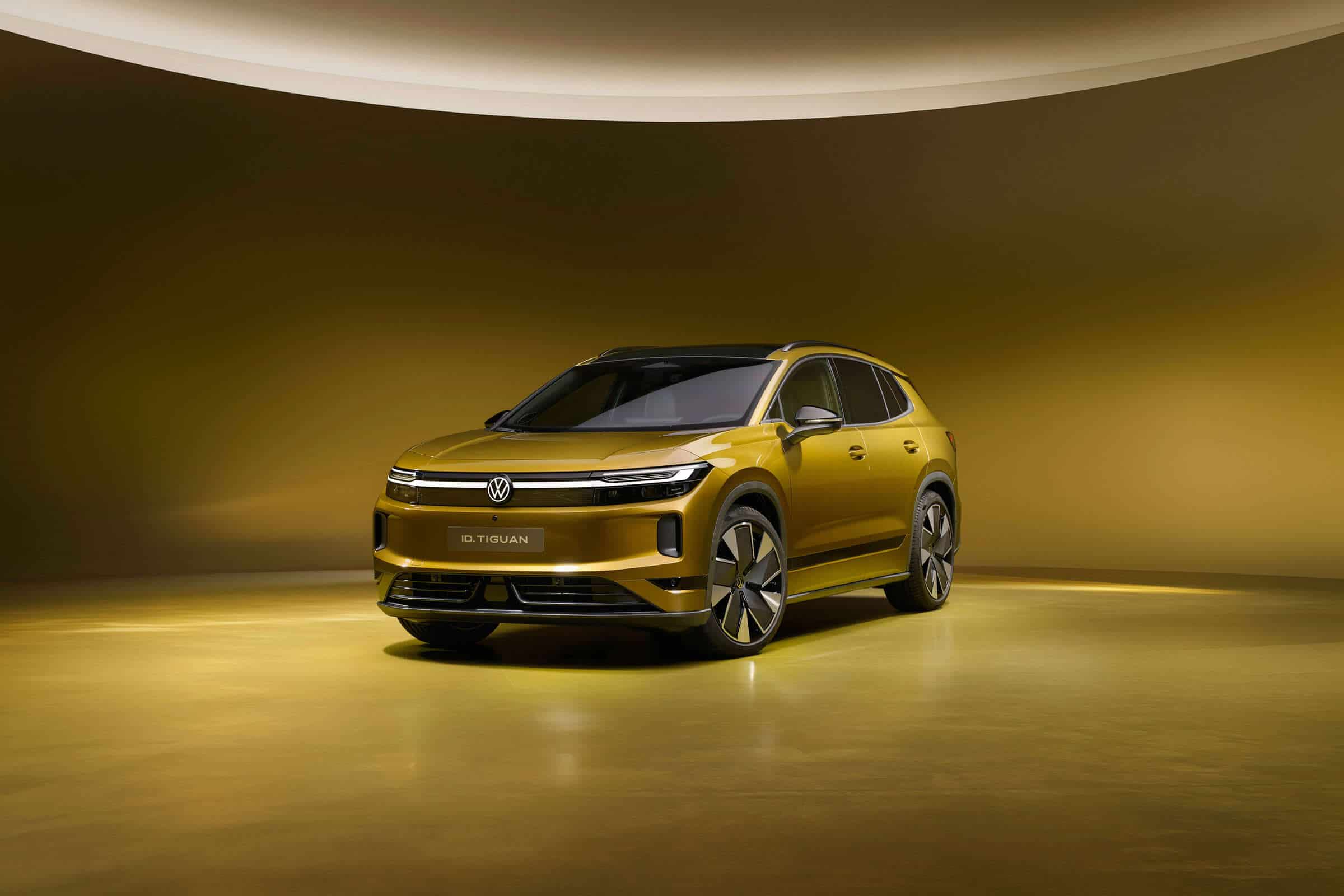
The electric ID. Tiguan is scheduled to arrive at the beginning of 2027, sold in parallel with the current Tiguan, which continues with gas, diesel and hybrid drives. Pre-sales begin on October 13 in Germany and many other European countries, with prices starting at 42,695 euros. Volkswagen notes that equipment specifications and pricing refer to the German market and that details may differ elsewhere.
The electric ID. Tiguan is scheduled to arrive at the beginning of 2027, sold in parallel with the current Tiguan, which continues with petrol, diesel and hybrid drives. Pre-sales begin on October 13 in Germany and many other European countries, with prices starting at 42,695 euros. Volkswagen notes that equipment specifications and pricing refer to the German market and that details may differ elsewhere.
Two Success Stories, One Name
Thomas Schäfer, CEO of the Volkswagen brand, framed the launch as a merger of two established lines. “The Tiguan is our bestselling model worldwide, and the ID.4 and ID.5 are among our most successful electric cars,” he said. “The ID. Tiguan brings these two success stories together.”
Schäfer described the result as a design with the presence of a vehicle from the next class up, paired with intuitive operation and, thanks to the MEB+ platform, a range of up to 600 kilometres (about 373 miles). He called it a new benchmark for the company’s electric SUVs made in Germany. The ID. Tiguan is built in Emden, and Schäfer said it joins the Tiguan from Wolfsburg as part of one of the strongest SUV duos in Europe.
A Harder-Edged Design
The exterior marks a visible departure from the vehicles it replaces. Volkswagen says the softer crossover shapes of the ID.4 and ID.5 have given way to a more powerful SUV design with a strong visual presence, built around precise lines and tightly sculpted surfaces. The company credits its Pure Positive design language and says the result gives the model the look of a premium-segment vehicle.
One detail is a deliberate step back. Volkswagen is returning to classic pull-style door handles on the ID. Tiguan.
Three Drive Levels, Up to 600 Kilometres (373 Miles)
Buyers will be able to choose among three performance levels. The first is a rear-wheel-drive version with 140 kW (190 PS) and a 58 kWh battery. The second is a rear-wheel-drive version with 210 kW (286 PS) and a 77 kWh battery. At the top is a 4MOTION all-wheel-drive variant producing 220 kW (299 PS), also with the 77 kWh battery.
Depending on output and battery size, WLTP range reaches up to 600 kilometres (about 373 miles), a figure Volkswagen says was determined in the most range-favourable equipment variant and may differ with equipment. Combined power consumption for the 220 kW version is listed at 17.2 to 15.7 kWh per 100 kilometres (about 27.7 to 25.3 kWh per 100 miles). The company’s footnotes add that real-world range varies with driving style, speed, use of comfort and auxiliary consumers, outside temperature, passengers and load, topography and the ageing of the high-voltage battery.
Towing capacity reaches 1,800 kilograms (about 3,968 pounds) with the 58 kWh battery and 2,000 kilograms (about 4,409 pounds) with the 77 kWh battery. Luggage space is up to 534 litres (about 18.9 cubic feet), supplemented for the first time by a frunk with 32 litres (about 1.1 cubic feet) of stowage. The ID. Tiguan will be offered in four equipment versions: Trend, Life, Style and R-Line.
A Cabin Built Around Screens, and Buttons
The most conspicuous change inside is the display landscape. A 10-inch Digital Cockpit sits ahead of the driver, and a 15-inch infotainment display occupies the centre, both new. Optionally, a 12-inch co-driver display extends the arrangement across the dashboard, which Volkswagen says is the first time a feature like this has appeared in a European Volkswagen.
The passenger screen is designed so that it is not visible to the driver, much like a laptop privacy screen. In privacy mode, the front passenger can watch, browse or play games and listen through paired Bluetooth headphones, without distracting the driver, according to the company.
Alongside the screens, Volkswagen has restored physical controls. Important functions are again reached through buttons, including a button bar in the centre console for basic climate settings and a controller in the centre console for audio volume and for changing stations or tracks. The multifunction steering wheel uses physical buttons in place of touch controls, and the in-door panel for the four power windows has been redesigned. Two inductive charging points compliant with the Qi2 standard, available as optional equipment, sit at the front, with integrated magnetic rings that position and secure compatible smartphones.
Volkswagen describes the materials as a major leap forward in quality and says elegant lighting effects and a considered colour scheme give the interior an atmosphere reminiscent of the next segment up.
A Nod to the Golf IV
The cabin also includes an element of nostalgia. A new “Retro” display mode, activated with the View button on the steering wheel, brings the blue-and-red instruments of the Golf IV into the Digital Cockpit. A classic speedometer sits on the left, and a stylised rev counter on the right shows not engine speed but the energy flow in the drive, as a power display.
The corresponding Retro view on the central screen can be personalised for the first time. Drivers can choose from six Volkswagen models shown in a virtual garage: the Golf I, Golf II Country, Golf IV, Tiguan I, Race Touareg and Beetle.
Driver Assistance and Comfort Features
One-pedal driving, which provides strong deceleration through the accelerator pedal alone, is standard. The new Connected Travel Assist, an option, enables assisted lane changing on motorways and automatically stops the vehicle at red traffic lights. Volkswagen states that both functions operate within system limits and that the driver remains responsible.
Comfort options include electrically adjustable front seats with massage, memory and ventilation functions, a 480-watt Harman Kardon sound system and a panoramic sunroof. A Digital Key, also optional, allows a compatible smartphone to unlock, lock and start the vehicle, and the key can be shared with family members, friends or colleagues through the Volkswagen app by text message, messenger service or email.
A PowerSocket for vehicle-to-load use is likewise offered. The adapter plugs into the charging socket and can power devices ranging from electric grills to e-bikes.
Part of a Wider Electric Push
The launch comes as Volkswagen positions its electric lineup within its “BOOST 2030” strategy, which the company describes as an effort to become the most desirable brand for sustainable mobility. The Volkswagen Passenger Cars brand delivered more than 4.7 million vehicles in 2025, including around 382,000 all-electric vehicles, and employs about 170,000 people worldwide.