From Factory Lot to Public Streets
Elon Musk confirmed in an April X post that manufacturing of the dual-seat Cybercab had begun at the Austin-area plant. By late July, close to 250 units had reportedly been spotted in factory lots as Tesla built up fleets destined for service areas that now include Austin, Houston, Dallas, Miami, Tampa, and Orlando. A report from The Information indicates the company has begun telling employees to ready themselves for a public launch event, and Tesla’s official Robotaxi account has been promoting a sweepstakes tied to that event, offering riders through August 23 a chance to attend.
The deployment path Tesla has described follows a deliberate, staged approach. Cybercab rides on public roads will go to Tesla employees before the vehicle is folded into the company’s public robotaxi service in Austin. Musk addressed the pacing directly during Tesla’s second-quarter earnings call, telling investors the company needed to build up driving data specific to the Cybercab’s new platform before putting many of them on the road, and separately stressed the need for caution to avoid causing harm during the rollout.
That employee-first phase functions as a controlled validation step, allowing Tesla to gather Cybercab-specific driving data on a new hardware platform before expanding exposure to paying riders. The vehicle currently operates only within small geofenced zones where Tesla’s software has been validated; outside those boundaries, without a steering wheel or pedals, it cannot be driven at all.
Why a Robotaxi Needs a Satellite Dish
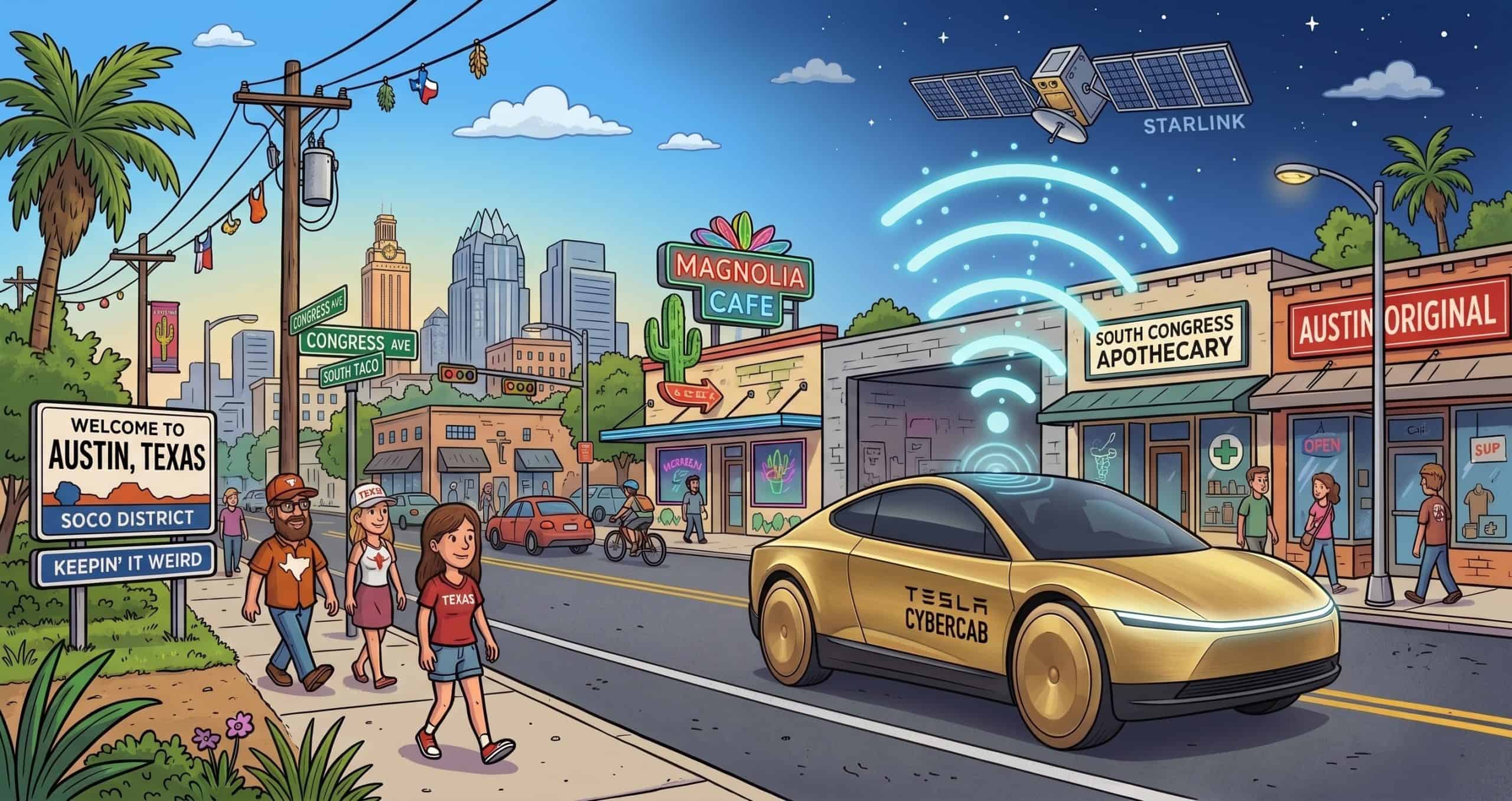
The most closely watched addition to the latest test units is a Starlink antenna, first shown publicly on August 10 when Tesla’s Robotaxi account posted photos captioned simply as the first Cybercab with Starlink integration. The hardware follows a July announcement from Tesla and Starlink describing the satellite link as directly integrated into the vehicle, though that earlier disclosure involved only a rendering rather than a production car.
The antenna itself is reported to be Tesla’s newest terminal, offering download speeds around 375 megabits per second while drawing significantly less power than the prior generation, according to Motor1’s reporting on the rollout. Tesla has framed the system’s purpose narrowly: it supports navigation data, customer service communications, and fleet management, not the onboard autonomy stack itself, which runs on the vehicle’s AI4 computer independent of any internet connection.
Musk elaborated on the reasoning during Tesla’s July 22 earnings call, pointing to gaps and outright dead zones in cellular coverage and stating that a robotaxi fleet cannot afford to lose contact with riders or Tesla’s systems when cellular service disappears. Pairing terrestrial 5G and LTE connections with a satellite backup gives Tesla two physically separate network paths, reducing the fleet’s dependence on any single layer of coverage. In the current operating cities, where cellular infrastructure is already dense, the practical benefit is limited; the more likely payoff comes if and when Tesla pushes robotaxi service into more remote or lower-coverage territory, where a satellite fallback becomes a genuine necessity rather than a redundancy.
Remote Monitoring Remains Part of the Safety Net
Connectivity upgrades aside, human oversight has not disappeared from the equation. Testing already underway in Austin, Chicago and San Francisco includes a remote monitoring layer, allowing a human operator to take over driving functions when needed, a fallback that runs alongside the vehicle’s Starlink and cellular links rather than replacing them.
A Tight Timeline With a History of Slipping
Tesla’s own signals point to an end-of-August target for the first public Cybercab rides, a window that leaves little room for delay. The company has missed self-set robotaxi milestones before, and skeptics have questioned why a vehicle that cannot yet be sold or driven outside narrow geofenced zones is being mass-produced ahead of regulatory and software validation. Still, the combination of hundreds of completed units at Gigafactory Texas, months of public-road testing, an employee-ride program already running, and now factory-installed Starlink hardware suggests the operational pieces for a limited public debut are largely in place. Confirmation of an exact date is expected to come directly from Tesla in the days ahead.