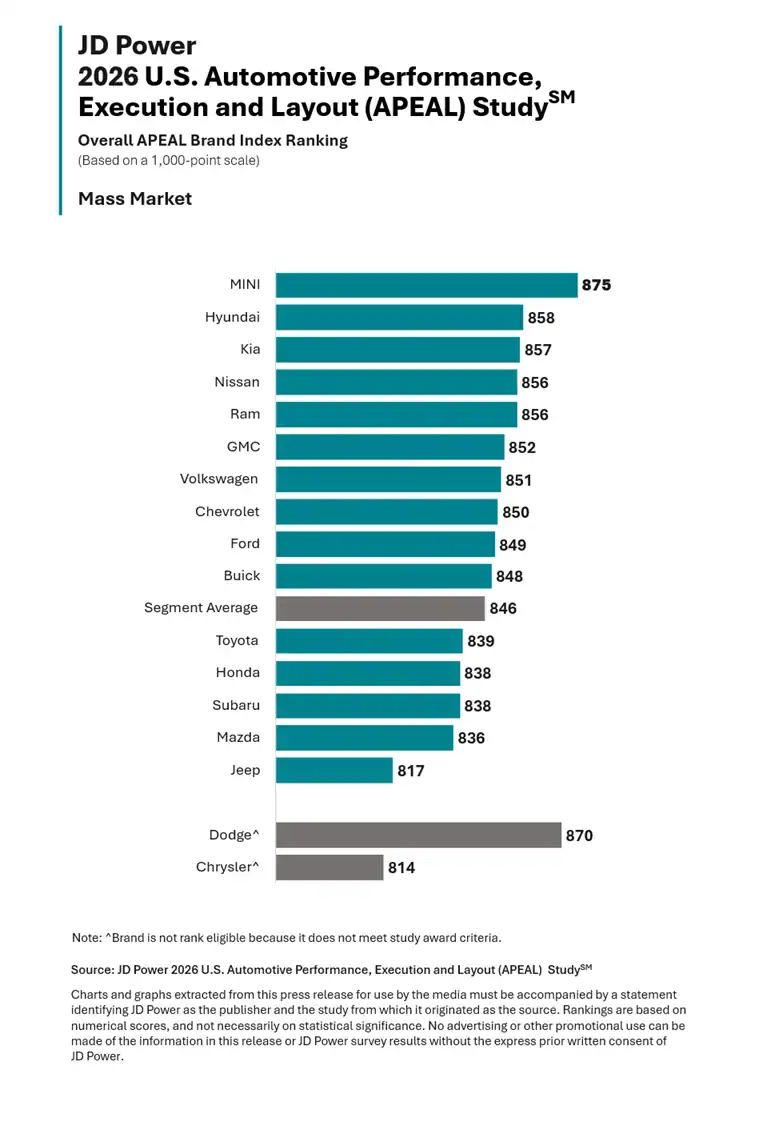
Quality Gains Are Translating Into Emotional Appeal
The APEAL results track closely with JD Power’s companion 2026 U.S. Initial Quality Study, and together the two paint a consistent picture: as the number of problems owners experience continues to fall, their satisfaction with how a vehicle looks, feels and performs continues to rise. Frank Hanley, senior director of auto benchmarking at JD Power, said automakers have made real strides in reducing defects, but quality by itself no longer wins over an owner. Vehicles need to feel deliberately designed, with comfortable seating, smart storage and infotainment systems that do not require a learning curve. Brands that manage to deliver on both fronts, he said, are the ones earning the strongest customer advocacy.
Interior Design Leads the Charge
Nearly every category measured in the study improved year over year, but interiors posted the largest gain, up 11 points. Owners responded favorably to more thoughtful storage solutions, including redesigned cupholders, better phone placement and more usable center console layouts. Exterior styling and ease of entry and exit each rose 10 points, underscoring how much everyday livability now shapes an owner’s overall impression of a vehicle, sometimes more than horsepower or styling flourishes ever did.
New Models No Longer Guarantee a Wow Factor
For the fifth year running, brand-new models are barely outperforming their carryover predecessors, scoring only two points higher on average. The premium segment saw new models actually underperform carryover vehicles by three points, while new mass-market models outpaced their carryover counterparts by 12 points. Persistent frustrations with infotainment systems, initial vehicle setup and unfamiliar technology features appear to be dragging down what should be a moment of excitement for owners unboxing the latest version of a favorite nameplate.
The Premium-Mass Market Gap Keeps Narrowing
Perhaps the most telling trend in this year’s study is how much ground mass-market brands have closed on their premium counterparts. Excluding Tesla, the emotional satisfaction gap between premium and mass-market brands has shrunk to just 29 points, down from 66 points in 2008. Premium brands no longer hold a clear edge in areas like infotainment, exterior design, driver-assistance technology, headlight performance or even the sound of a door closing. Increasingly, owners appear to be judging a premium experience by how well a vehicle is executed rather than by the badge on the hood.
Electric Vehicles Post the Biggest Owner Gains
While satisfaction rose across every powertrain type this year, battery electric vehicles saw the sharpest improvement, climbing 22 points. BEVs now outperform internal combustion vehicles in nearly every measured category, with the widest margin coming in powertrain satisfaction, where electric vehicles beat gas-powered models by a striking 109 points. That gap suggests the driving experience itself, rather than range anxiety or charging infrastructure, may be winning converts among owners who have already made the switch.
Porsche and MINI Hold Onto the Top Spots
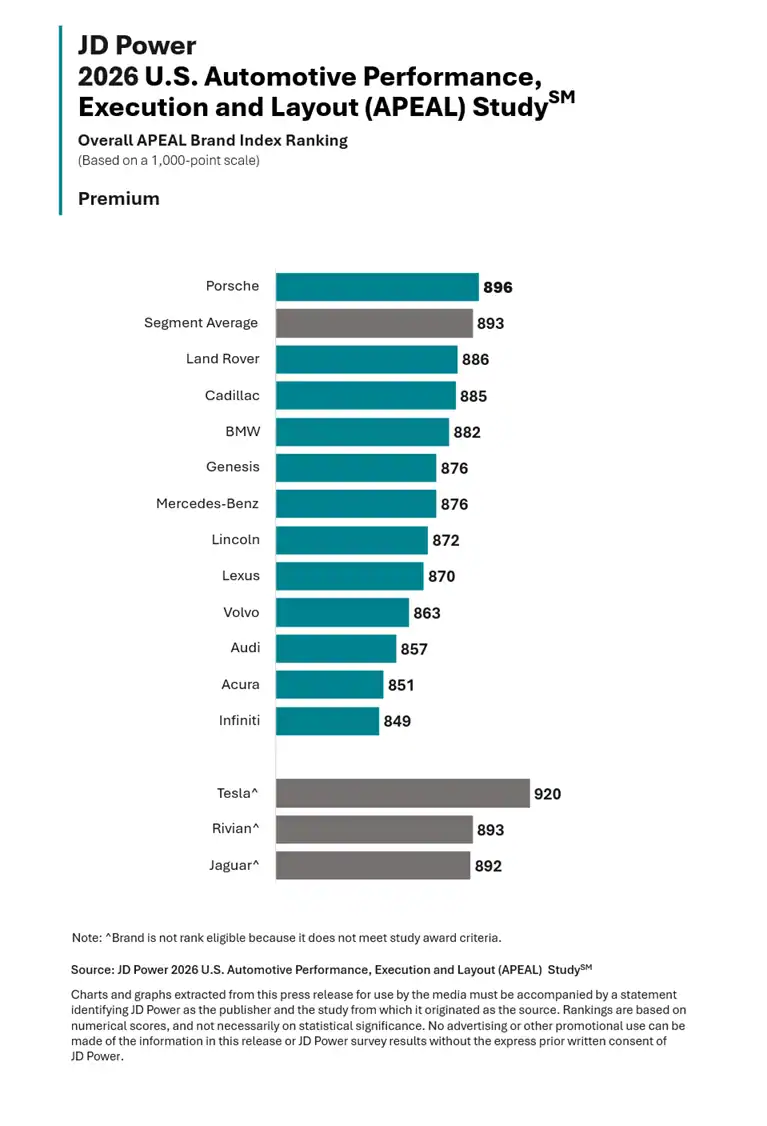
Porsche once again ranks highest among premium brands, the third year in a row it has claimed the title, with a score of 896 that stands well above the segment average. MINI leads the mass-market field for the third consecutive year with a score of 875, followed closely by Hyundai at 858 and Kia at 857.
BMW Leads a Crowded Field of Model-Level Winners
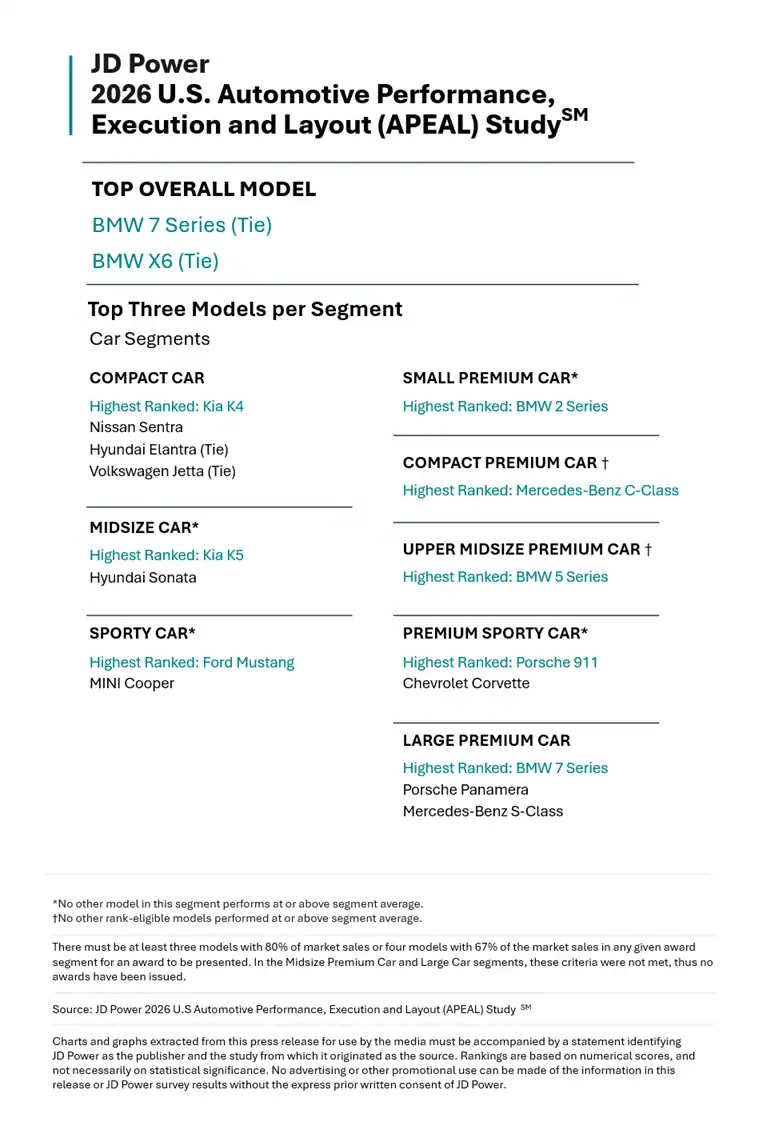
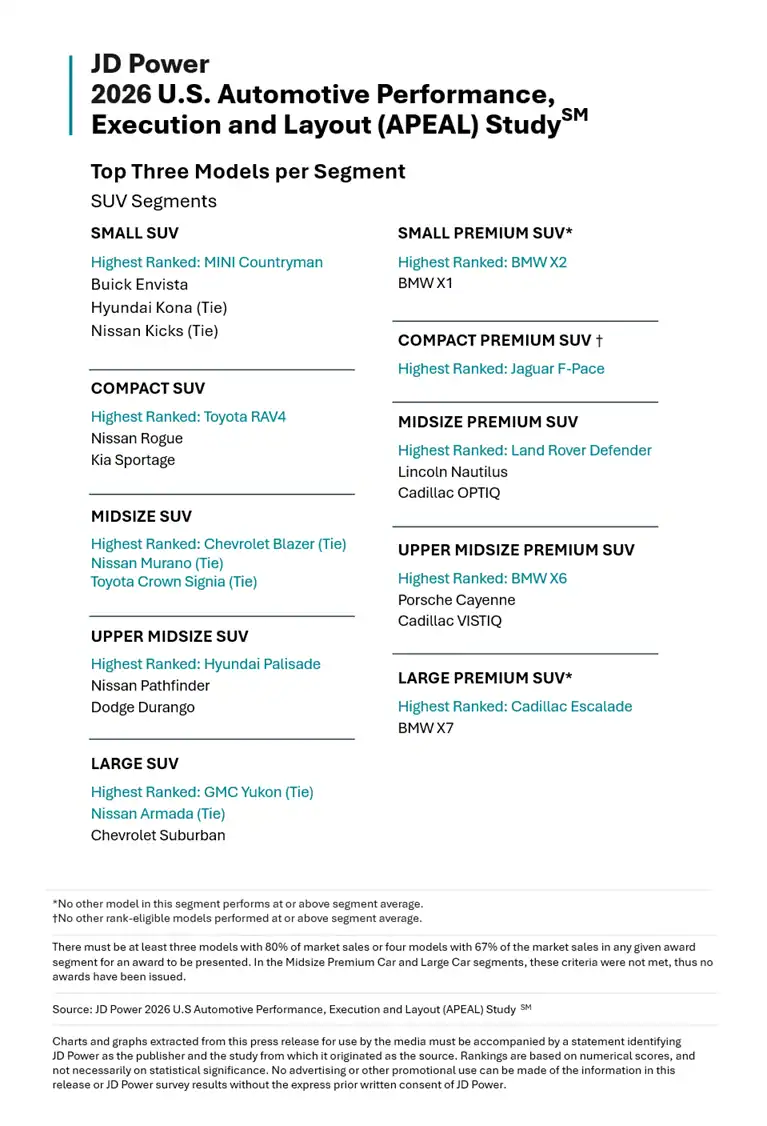
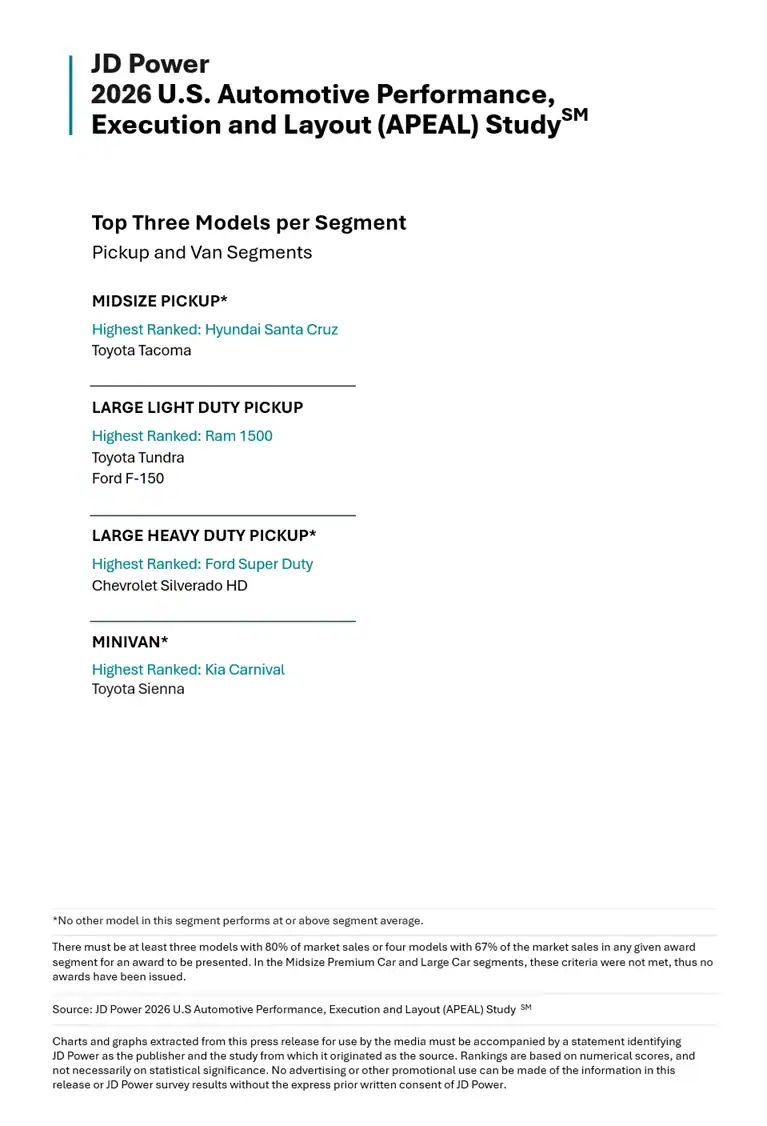
BMW AG collected the most model-level awards this year, with six vehicles named tops in their respective segments: the BMW X2, X6, 2 Series, 5 Series and 7 Series, along with the MINI Countryman. Hyundai Motor Group followed with five segment wins across the Hyundai Palisade and Santa Cruz and the Kia Carnival, K4 and K5. General Motors took three awards with the Chevrolet Blazer, GMC Yukon and Cadillac Escalade.
The BMW X6 and BMW 7 Series tied as the highest-ranking individual models overall, with the X6 repeating its win from last year. The Kia K5 extended its streak to six consecutive years as a model-level award winner, while the MINI Countryman has now won four years running and the Ford Super Duty three. The Ford Mustang, Hyundai Santa Cruz, Kia K4, Nissan Murano and Porsche 911 each picked up their second consecutive award.
Other automakers earning model-level recognition included Ford Motor Company for the Super Duty and Mustang, JLR for the Jaguar F-Pace and Land Rover Defender, Nissan for the Murano and Armada, Toyota for the RAV4 and Crown Signia, Mercedes-Benz for the C-Class, Stellantis for the Ram 1500 and Volkswagen AG for the Porsche 911.