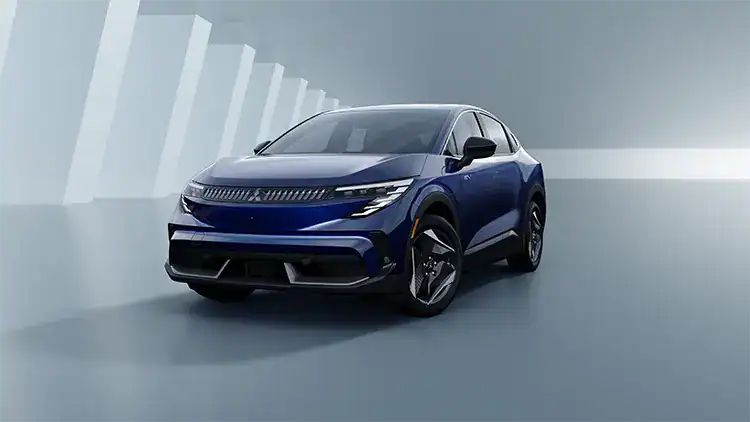
Mitsubishi Motors is betting that nostalgia and electrification make a powerful combination. The automaker announced June 9 that it will debut the 2027 Mitsubishi Eclipse Sportback — an all-new battery electric vehicle — in the North American market in late summer or early fall of this year, marking both the return of an iconic name and the company’s most significant EV launch in over a decade.
The Eclipse name resonates with a generation of American car buyers. The original Eclipse debuted in North America in 1990 and became a cultural touchstone through the 1990s and 2000s, appearing in everything from motorsport programs to The Fast and the Furious franchise. The nameplate was retired after the 2012 model year. Its return — now applied to a sporty electric subcompact SUV — signals Mitsubishi’s intent to reconnect with lapsed loyalists while chasing younger buyers who never knew the original.
Sourced from the Alliance, Styled as Mitsubishi
The Eclipse Sportback EV is built on the platform of the next-generation Nissan LEAF, developed through Mitsubishi’s longstanding Renault-Nissan-Mitsubishi Alliance partnership. The arrangement mirrors similar badge-engineering strategies used across the alliance — most recently with the Nissan Ariya and Mitsubishi Airtrek in select global markets — but the Eclipse Sportback is positioned as a North America-first global debut, not a leftover from another market.
Mitsubishi has been deliberate about differentiating the Eclipse Sportback visually from its Nissan sibling. The vehicle features unique front and rear fascias designed to echo the styling language of the brand’s current global lineup, distinct lighting signatures front and rear, and alloy wheels exclusive to the model. The Triple Diamond badging, Mitsubishi’s iconic brand mark, features prominently throughout.
The underlying LEAF platform brings considerable expectations. Nissan has signaled that the next-generation LEAF — long overdue for a full redesign after years on a legacy platform — will move to a more competitive architecture with updated battery and powertrain technology. Technical specifications for the Eclipse Sportback, including range, charging capability, and powertrain output, have not yet been released. Pricing and final on-sale timing are similarly pending.
A Company With a Long EV Résumé
Mitsubishi’s EV credentials predate most of the industry. The company began developing fully electric vehicles in Japan in the 1970s, and in 2009 introduced the i-MiEV — widely recognized as the world’s first mass-produced electric vehicle — in select markets. The i-MiEV reached the United States and Canada in late 2011. A year later, Mitsubishi launched the Outlander PHEV globally, a vehicle it claims was the world’s first plug-in hybrid SUV; North America received that model in 2018.
The Eclipse Sportback BEV is framed as the next chapter in that lineage — though the company will need the new model to do heavier lifting commercially than either the i-MiEV or the Outlander PHEV managed in the U.S. market.
Momentum 2030 and the Road Ahead
The Eclipse Sportback launch is central to Mitsubishi’s Momentum 2030 five-year business plan, which the Franklin, Tennessee-based North American headquarters unveiled as a framework for product and retail transformation. The plan calls for at least one new or significantly revised vehicle per year through fiscal-year 2030, with electrification — spanning battery electric, plug-in hybrid, and hybrid powertrains — as one of four strategic pillars alongside product expansion, a modernized retail model, and dealer network investment.
The Eclipse Sportback will be followed in early 2027 by what Mitsubishi describes as an all-new rugged, off-road derivative of the Outlander SUV, signaling that the brand intends to play both ends of the market: urban-focused EVs and body-on-frame-adjacent adventure vehicles.
Mitsubishi currently sells four vehicles in the U.S. through approximately 300 dealer partners. The Momentum 2030 plan calls for nearly doubling that lineup by 2030.