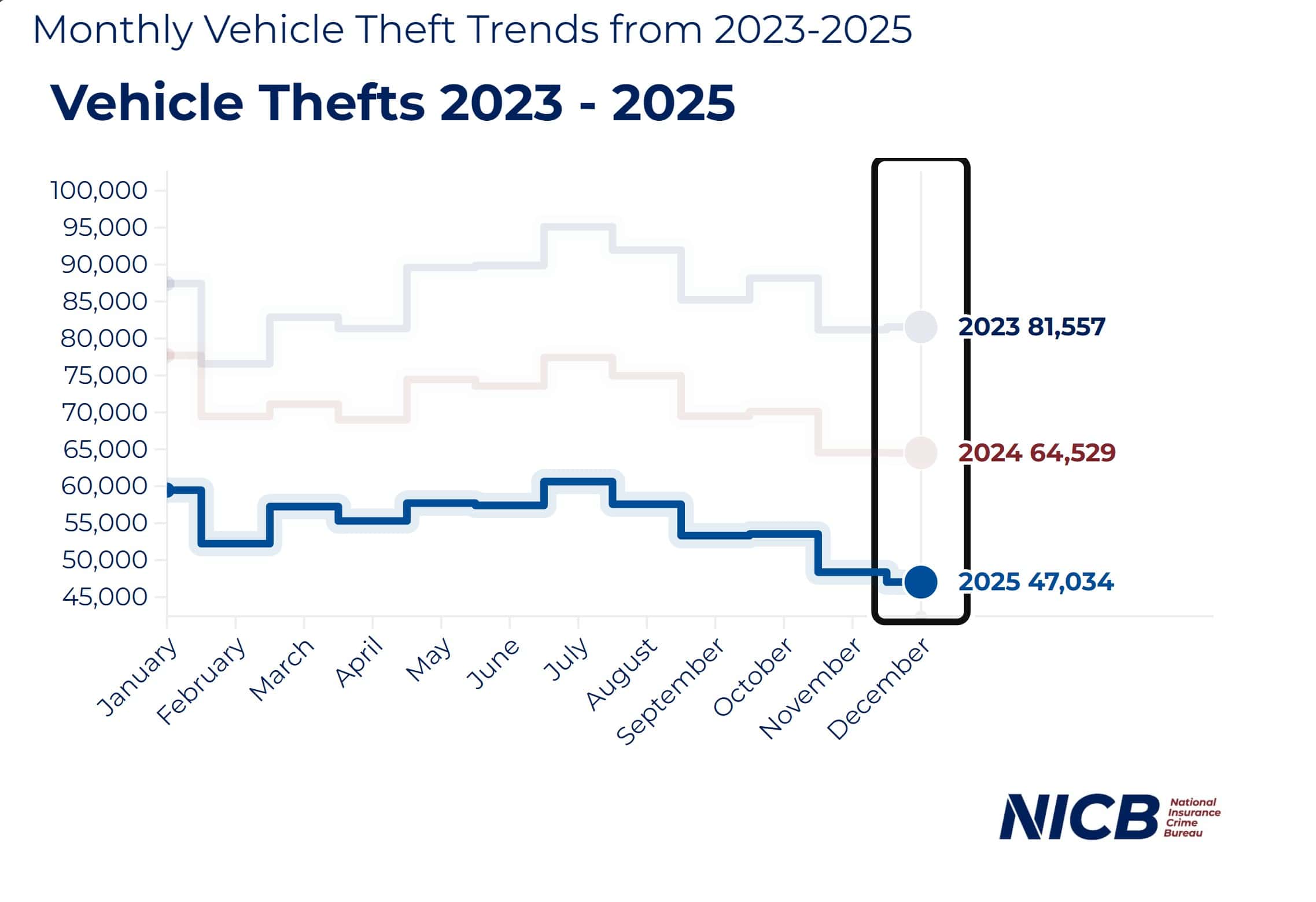
The National Insurance Crime Bureau, the nonprofit that tracks and investigates insurance fraud on behalf of more than 1,200 insurers, is marking National Vehicle Theft Prevention Month this July by pointing to the numbers behind that shift. According to the bureau’s 2025 Vehicle Theft Report, released in March, reported thefts across the country dropped 23.2 percent from 2024 to 2025, falling from 850,708 stolen vehicles to 659,880. That amounts to roughly 190,800 fewer thefts in a single year.
A Decline Built on Coordination, Not Coincidence
David J. Glawe, the bureau’s president and chief executive, has been careful to frame the drop not as luck but as the payoff of years of overlapping effort. He has described the decline as the product of coordinated work among law enforcement, state theft-prevention authorities, policymakers, automakers, insurers and the public — the kind of alignment that rarely happens by accident in American crime policy.
That coordination looks different depending on where you live, but a pattern has emerged in the states that saw the steepest declines. Colorado, Texas and Washington each recorded major drops in theft volume, and each has something in common: dedicated state authorities built specifically to fight vehicle theft, paired with tougher criminal penalties passed in recent years. Glawe has held those three states up as a model, arguing that durable infrastructure — public awareness campaigns, law enforcement support, grant funding and close partnership with groups like his own — produces a public safety strategy that survives beyond a single budget cycle or news cycle.
Where the Numbers Moved Most
Nearly every state posted a decline in 2025, but the scale varied widely. California led the country in raw numbers, recording 45,278 fewer thefts than the year before. Texas followed with 23,027 fewer thefts, and Washington posted a drop of 11,617. Florida, Colorado, Georgia, Missouri, Tennessee, Illinois and Michigan rounded out the states with the largest declines, each shedding several thousand fewer stolen vehicles than in 2024.
The breadth of the decline — touching large and small states, coastal and interior ones alike — is part of what has convinced the bureau that something structural is happening, rather than a statistical blip confined to one region or one type of theft.
The Warning Behind the Good News
Still, the bureau is wary of declaring victory. Even after the steepest single-year drop in recent memory, more than 659,000 vehicles were stolen in the United States last year. And the criminal networks behind organized theft rings are not standing still; the bureau warns they continue to adapt, finding new vulnerabilities as vehicles grow more connected and more computerized.
That tension — real progress paired with real risk — is shaping the bureau’s advocacy this month. It is pressing for continued funding of law enforcement theft units, sustained state investment in dedicated theft-prevention authorities, stronger penalties and more consistent prosecution, updated laws that account for high-tech theft methods, and stronger protections for victims navigating the aftermath of a stolen car.
What Drivers Can Still Control
Behind the policy debate, the bureau’s advice to individual drivers has changed little, a reminder that most vehicle theft still comes down to opportunity rather than sophistication. Parking in well-lit areas and rolling up windows before stepping away remain basic deterrents. So does locking the doors — investigators note that some thieves simply walk down rows of parked cars testing handles until one gives. Leaving a car running and unattended, even for a moment, is treated as close to an invitation. And keys, the bureau stresses, should never stay behind, even for what feels like a thirty-second errand.
For drivers who want an added layer of protection, the bureau points to steering wheel locks, audible alarms, kill switches and aftermarket GPS trackers, including consumer tracking tags, which can both deter theft and speed recovery if a vehicle is taken anyway.
A Fragile Kind of Progress
What emerges from the bureau’s report is less a victory lap than a snapshot of a problem in retreat but not resolved. The steepest theft decline in decades did not happen because criminals lost interest in stealing cars. It happened, the bureau argues, because states built the infrastructure to make theft harder, prosecute it more consistently, and share information faster than the networks trying to exploit new vulnerabilities. Whether that progress holds through 2026 may depend less on any single new technology than on whether the coordination behind last year’s numbers survives the next round of state budgets.
Meanwhile, the Hyundai Elantra is currently the most-stolen vehicle in America, with Hyundai and Kia vehicles making up 14% of all 2025 thefts. So if you are Kia or Hyundai owner, be careful and aware.