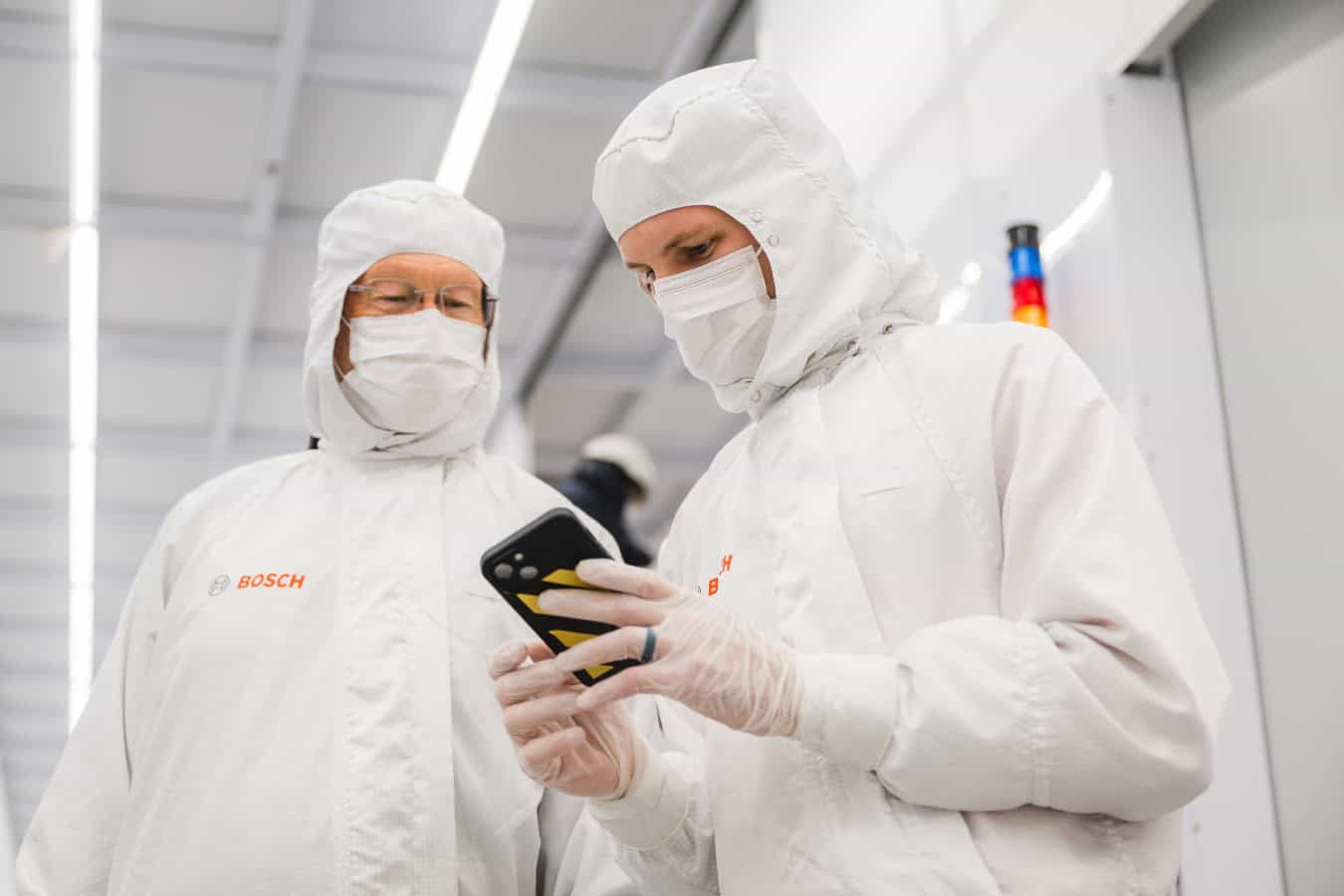
The announcement lands the semiconductor industry’s broader wager on electrification squarely in a Sacramento suburb best known for outlet malls and commuter subdivisions — and it does so at a moment when the politics of industrial policy in Washington have shifted considerably since the CHIPS and Science Act was signed into law.
A Fab With a Past, Now Rebuilt for an Electric Future
The Roseville site is not a greenfield project. It has produced semiconductors for nearly 40 years, most recently as the former TSI Semiconductors campus, before Bosch announced its intention to acquire the assets in April 2023. The deal closed that August, and the company has spent the time since retraining the facility’s workforce and rebuilding its production line around a single material: silicon carbide, a compound prized for its ability to handle higher voltages, higher temperatures and faster switching than conventional silicon while losing less energy as heat.
That property has made silicon carbide the material of choice for the power electronics inside electric vehicles — the traction inverters, onboard chargers and fast-charging equipment that determine how efficiently a car turns battery energy into motion. Automotive analysts tracking the broader chip market have described power discrete semiconductors, and silicon carbide devices in particular, as one of the fastest-growing segments of vehicle electronics even as automakers compete with data centers and artificial intelligence infrastructure for foundry capacity. Industry researchers tracking the sector have projected the global silicon carbide market to keep expanding at a compound annual growth rate in the double digits through the early 2030s, propelled largely by electric vehicle adoption and, more recently, renewable energy and grid infrastructure.
Bosch is wagering that owning a piece of that supply chain domestically, rather than relying solely on suppliers in Asia and Europe, will matter to the automakers and industrial customers it serves.
Washington’s Money, With a Different Political Accent
The $225 million commitment flows through the Commerce Department’s CHIPS Program Office, the body created under the 2022 CHIPS and Science Act to disburse federal incentives for domestic semiconductor manufacturing. But the deal was struck, and announced, under an administration that has approached the program differently than the one that signed it into law, framing chip investment less around global competitiveness broadly and more around supply chain security tied to specific industries.
“The Trump Administration is committed to developing a secure supply chain here in the United States that will enable continued innovation and competitive leadership in industries of national and economic security importance,” Commerce Secretary Howard Lutnick said in a statement accompanying the announcement.
For Bosch, the framing lines up with what the company says its customers have been asking for directly. “The start of sample production and our agreement with the Department of Commerce is a milestone in providing our local customers with what they have requested — localized U.S.-based manufacturing,” said Paul Thomas, president and chief executive of Bosch in North America, adding that domestic production would draw on the expertise of American manufacturing associates to bring the technology to market on a faster timeline.
The federal award is layered on top of a separate $25 million California Competes Tax Credit from the state’s Governor’s Office of Business and Economic Development, intended to support redevelopment of the Roseville site — a reminder that the fight to land advanced manufacturing jobs plays out at the state level as much as the federal one.
What It Means for Roseville
For a city of roughly 150,000 people better known for its regional mall and its role as a rail hub than for advanced manufacturing, the stakes are tangible. The Roseville plant currently employs more than 300 associates, a number Bosch says could grow as the facility ramps toward commercial production and market demand develops. The company has also committed to spending more than $100,000 annually on developing local semiconductor talent, an acknowledgment that the same workforce shortages constraining chip plants in Arizona, Ohio and Texas exist in the Sacramento region as well.
Representative Doris Matsui, whose district includes Roseville, cast the announcement as validation of years of regional groundwork, telling local reporters that the federal investment reflected a Sacramento-area economy built to lead in advanced manufacturing for years to come.
The math behind the current project is only part of a larger figure Bosch has attached to its American ambitions. The company says it intends to invest up to $7.5 billion in its U.S. operations by 2031, the year it will mark 125 years of doing business in the country — a milestone that arrives five years after it celebrates its 120th anniversary this year.
A Long Bet on a Small Chip
What happens inside the Roseville cleanroom over the next several years will be largely invisible to the drivers and factory operators who eventually rely on the chips it produces. Silicon carbide semiconductors do not carry a brand name the way a car or a battery pack does; their job is to sit quietly inside an inverter or a charger, converting electricity a little more efficiently than the silicon that came before it.
But the wager Bosch and the Commerce Department are making together is that efficiency, multiplied across millions of vehicles and industrial systems, adds up to something that looks a lot like national strategy — and that a 40-year-old fab in a Sacramento suburb still has a role to play in deciding where that strategy gets built.