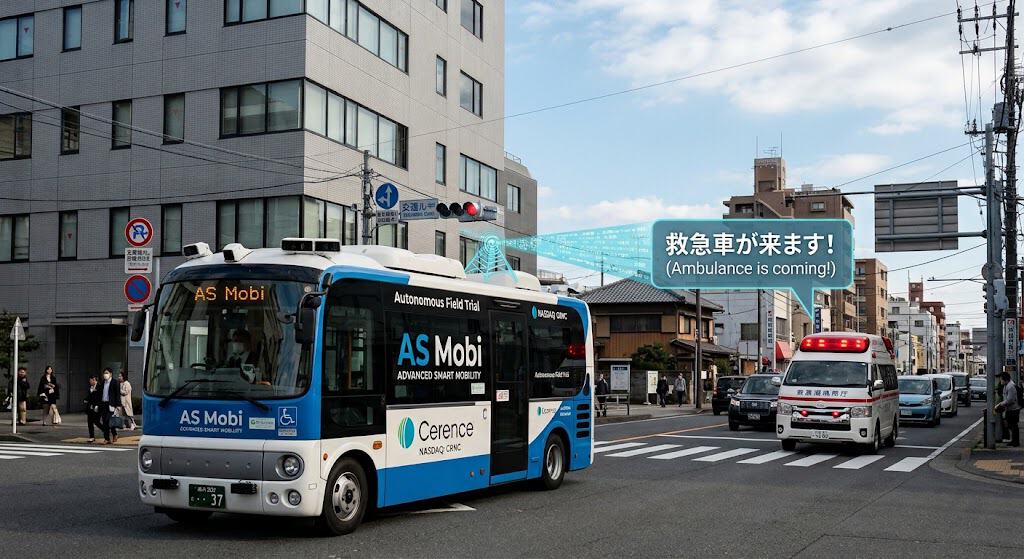
A New Layer of Situational Awareness
Cerence EVD is built around the company’s Audio AI platform, which listens for the acoustic signatures of approaching ambulances, fire trucks, and police vehicles and distinguishes them from the ordinary clutter of road noise, traffic, and weather. The system draws on a library of more than 1,500 distinct emergency sirens gathered across 47 countries, giving it the range to recognize the specific tones and patterns used by Japanese emergency services alongside those used elsewhere in the world.
What sets this deployment apart from Cerence’s earlier work is the move to exterior microphones mounted on the bus itself, rather than relying solely on interior cabin audio. That architectural shift extends the system’s detection range to beyond 800 meters, giving AS Mobi’s autonomous buses meaningfully more lead time to react before a siren becomes audible to passengers or before an emergency vehicle comes into view.
Filling the Gaps Cameras and Radar Cannot See
Autonomous vehicle platforms have long relied on a sensing suite of optical cameras, radar, and LiDAR to build a picture of the surrounding environment, but those tools share a common limitation: they require a direct line of sight. A fire truck approaching from around a blind corner, behind a building, or over a hill remains invisible to a camera or LiDAR unit until the last possible moment. By adding acoustic detection to the mix, Cerence EVD gives AS Mobi’s Level 4 autonomous buses a form of 360-degree, non-line-of-sight awareness that complements rather than replaces the existing sensor stack. In practice, that means a bus can begin to yield, slow, or plan a re-route well before an emergency vehicle physically enters its field of view, a capability that becomes increasingly important as autonomous transit moves off dedicated test corridors and into more complex, mixed-traffic environments.
Addressing Japan’s Transit Pressures
AS Mobi has built its business around Level 4 autonomous bus operations, including what it describes as Japan’s longest commercial autonomous bus route, a 6.1-kilometer bus rapid transit corridor developed in the aftermath of the Great East Japan Earthquake. That system combines magnetic markers with RTK-GPS for centimeter-level positioning and has been used to demonstrate stable autonomous operation in dedicated bus lanes. The current field trials push further, testing autonomous operation in mixed traffic, at complex intersections, and in high-density environments where buses must coexist with passenger vehicles, pedestrians, and bicycles.
The urgency behind that expansion is demographic as much as technological. Japan’s aging population and a persistent shortage of professional drivers have put sustained pressure on regional transportation networks, particularly outside the largest cities. AS Mobi has framed its autonomous mobility work as a direct response to that gap, and the company is targeting full commercial deployment of its autonomous bus transit services by 2027.
A Proof Point for Acoustic AI in Transit
For Cerence, the AS Mobi partnership serves as a proof point that its Audio AI technology, originally built around in-cabin, conversational, and driver-assistance use cases, can extend meaningfully into vehicle safety and autonomy. Emergency vehicle detection has been positioned by the company as increasingly essential infrastructure as autonomous transportation scales beyond pilot programs, since a self-driving bus that cannot reliably yield to a fire truck or ambulance is unlikely to earn public trust or regulatory approval for widespread commercial use.
The Japan trials will offer Cerence and AS Mobi a real-world test of how well acoustic detection performs across the country’s varied urban and regional driving conditions, from dense city intersections to rural roads with fewer sensory cues. If the technology performs as intended through the field trial period, it could become a standard component of AS Mobi’s sensor architecture as the company works toward its 2027 commercialization target, and a template for how Cerence positions EVD in future autonomous transit deployments beyond Japan.