Built on three generations of Rogue and nearly 4 million units sold, the redesigned SUV pairs that hybrid powertrain with sharper styling, more driver assistance capability and an interior that Nissan says outclasses rivals on comfort. The Rogue Hybrid reaches dealers in fall 2026, arriving first as an all-wheel-drive SR with the SR Technology Package. The broader lineup of SV, SR and Platinum trims follows in early 2027, with pricing starting at $35,490 for the SV grade.
“The all-new Rogue Hybrid is exactly what customers have been asking for: the functionality, technology and packaging of a Rogue, now paired with an advanced hybrid powertrain that enhances efficiency while delivering a dynamic driving experience,” said Ponz Pandikuthira, senior vice president, chief product and planning officer for Nissan Americas. He added that the instantaneous torque delivery, combined with a quiet and efficient powertrain, is meant to “redefine what hybrid means in this segment.”
A Powertrain With a Track Record
What sets e‑POWER apart is the absence of a conventional transmission. The system has already powered nearly 2 million vehicles across 68 countries since 2016, and for Rogue Hybrid, Nissan says it retuned the setup specifically for North American roads, speeds and driving habits. The result, according to the company, is smooth, responsive acceleration without the shift points and hesitation associated with more conventional hybrids. Owners still fuel up at any gas station, with none of the plug-in charging routine that comes with an EV.
Under the hood sits a dedicated 1.5-liter turbocharged engine tuned purely for quietness and efficiency. Rather than driving the wheels, it acts strictly as a generator and shuts off entirely once the battery holds enough charge, a design Nissan credits with 42% thermal efficiency and fuel economy estimates of up to 40 mpg city, 36 mpg highway and 38 mpg combined, based on internal testing.
Dual-motor electric all-wheel drive comes standard across the lineup, a point Nissan is eager to highlight against the Toyota RAV4 Hybrid and Hyundai Tucson Hybrid, neither of which offers AWD across their hybrid ranges. The system continuously shifts torque between the front and rear motors for traction and stability, and can apply light braking to the inside wheels for tighter cornering. Combined output lands at 225 horsepower.
Two braking technologies round out the driving experience. The class-exclusive e-Pedal lets drivers bring the SUV to a complete stop by simply lifting off the accelerator, while Smooth Stop modulates brake pressure automatically at the end of a stop to reduce head-toss, a small but noticeable refinement in stop-and-go traffic.
Screens, Gemini, and a Faster Wireless Charger
A standard 12.3-inch touchscreen with wireless Apple CarPlay and Android Auto comes on every Rogue Hybrid, while a 14.3-inch display with Google built-in, Google Maps, the Play Store and Google Gemini is optional on SR and standard on Platinum, which also adds a 10-speaker Bose Premium Audio system. Every trim gets a new 15-watt Qi2 magnetic wireless charger, with Platinum stepping up to dual chargers.
ProPILOT Gets Sharper Eyes
Nissan’s driver assistance suite has been meaningfully upgraded rather than simply carried over. A new front radar sensor and a front camera with a 20% wider field of view give the latest ProPILOT Assist more information to work with, and Nissan says the system now operates more naturally across a broader range of conditions than the outgoing Rogue.
Intelligent Cruise Control now offers four following-distance settings instead of three, works down to 12 mph at low speed, accelerates 11% quicker in that range, and detects slowing or stopped vehicles 33% sooner than before. Steering assistance has also improved, looking an additional second farther down the road with 12% more steering authority for smoother lane-centering through curves.
SR Technology Package and Platinum buyers gain Auto Lane Change, which steers into an adjacent lane once a driver signals on a clear divided highway between 37 and 85 mph, and Hands-off Traffic Jam Support, which permits temporary hands-off steering in slow highway congestion. A new Lead Car Departure Notification alerts drivers when the vehicle ahead starts moving, useful at a green light when attention has drifted. Standard safety technology includes Automatic Emergency Braking, Blind Spot Warning and Intervention, Lane Departure Warning and Intelligent Lane Intervention, while an available 3D HD Enhanced Intelligent Around View Monitor renders a transparent view of the vehicle to help spot curbs and obstacles, alongside Front Wide View and Invisible Hood View for tight intersections and car washes.
Refined and Tough, Inside and Out
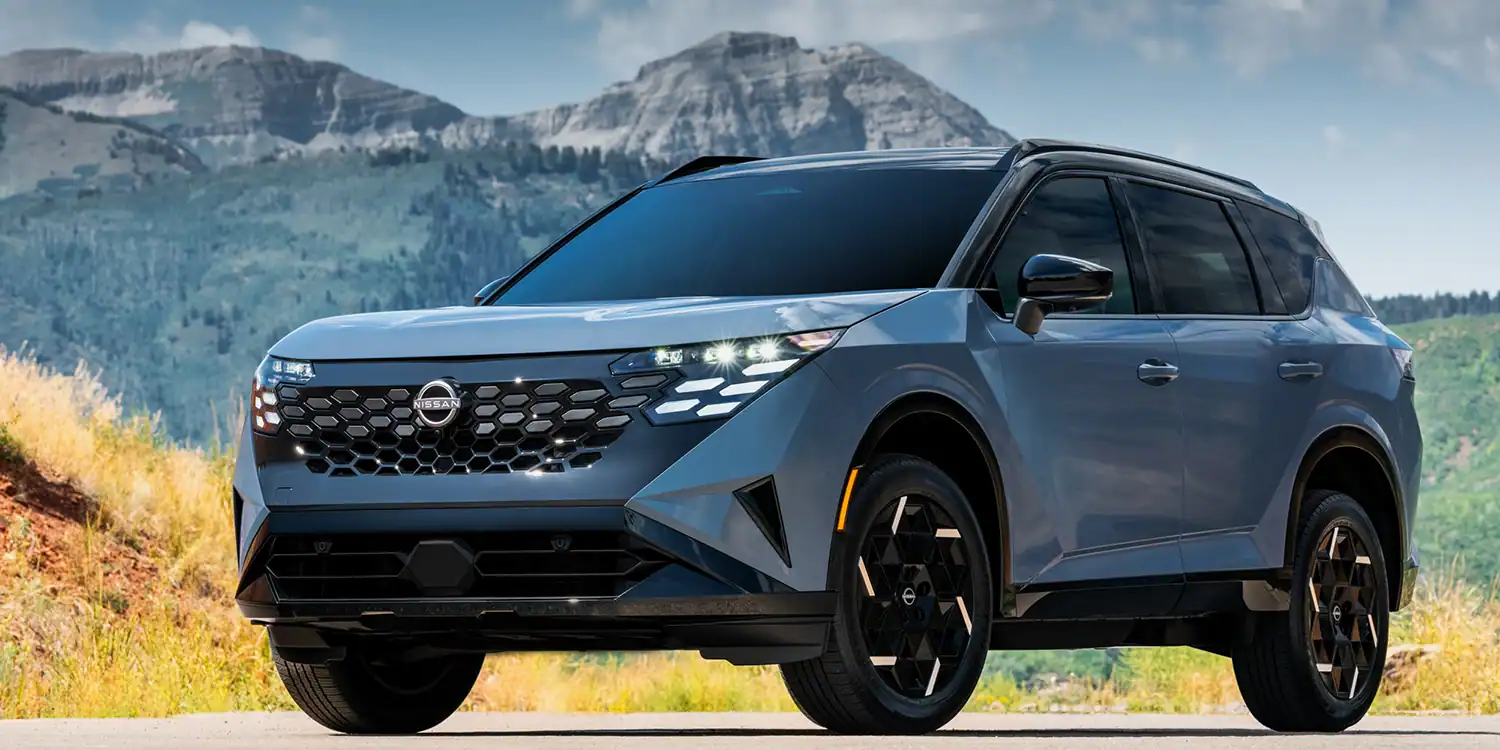
Nissan describes the new exterior as “Refined and Tough,” built around a hexagonal honeycomb grille, sharp-edged fenders and a wide, athletic stance. The new SR grade pushes the look further with unique fascias, distinct wheels and gloss black accents, while an available full-width LED tail light spans the liftgate. Buyers get eight colors and five two-tone configurations with a black roof, including three new additions: Horizon Blue Pearl Metallic, Alpine Metallic and Aurora Dune Pearl.
Inside, Nissan is leaning on space as a selling point, citing more front headroom than any hybrid in its class and class-leading front legroom among hybrids, edging out the RAV4 on both counts. Zero Gravity seating aims to cut fatigue on longer drives, while aerodynamic mirror shaping, acoustic-laminated glass and improved door sealing target a quieter cabin. The digital instrument cluster runs 12.3 inches standard and 14.3 inches on SR Technology Package or Platinum, and a new 64-color ambient lighting feature lets owners personalize the mood, though Nissan kept physical HVAC controls in place for use while driving.
Climate-controlled seats arrive in Rogue for the first time, with engineers redesigning the seatback to protect rear knee room while quieting the cooling system. Smaller touches carry through as well: an enlarged under-console storage opening for purses and everyday items, rear doors that swing open to nearly 90 degrees for easier car-seat installation, and five LATCH anchors in the second row, letting families install a center car seat or fit three across.
Cargo capacity reaches 31.1 cubic feet with the second row raised and 65.9 cubic feet folded, enough for three large suitcases side by side. A thinner inner liftgate trim frees up about 1.75 inches of additional trunk length, and Rogue’s signature “milk jug holder” behind the passenger-side wheel well returns. An optional luggage floorboard adds versatility, raising cargo height in its lower position and helping keep loose items from spilling out when the liftgate opens.
With the SR AWD arriving this fall and the full range following in early 2027, Nissan is wagering that the Rogue’s established popularity, combined with proven hybrid technology finally brought stateside, will be enough to pull hybrid shoppers away from the RAV4 and Tucson.
into an American bestseller. The all-new 2027 Rogue Hybrid marks the first time the automaker has brought this globally proven technology to the United States, and the company is framing it as a fundamentally different kind of hybrid rather than an incremental update to a familiar formula.
Built on three generations of Rogue and nearly 4 million units sold, the redesigned SUV pairs that hybrid powertrain with sharper styling, more driver assistance capability and an interior that Nissan says outclasses rivals on comfort. The Rogue Hybrid reaches dealers in fall 2026, arriving first as an all-wheel-drive SR with the SR Technology Package. The broader lineup of SV, SR and Platinum trims follows in early 2027, with pricing starting at $35,490 for the SV grade.
“The all-new Rogue Hybrid is exactly what customers have been asking for: the functionality, technology and packaging of a Rogue, now paired with an advanced hybrid powertrain that enhances efficiency while delivering a dynamic driving experience,” said Ponz Pandikuthira, senior vice president, chief product and planning officer for Nissan Americas. He added that the instantaneous torque delivery, combined with a quiet and efficient powertrain, is meant to “redefine what hybrid means in this segment.”
A Powertrain With a Track Record
What sets e‑POWER apart is the absence of a conventional transmission. The system has already powered nearly 2 million vehicles across 68 countries since 2016, and for Rogue Hybrid, Nissan says it retuned the setup specifically for North American roads, speeds and driving habits. The result, according to the company, is smooth, responsive acceleration without the shift points and hesitation associated with more conventional hybrids. Owners still fuel up at any gas station, with none of the plug-in charging routine that comes with an EV.
Under the hood sits a dedicated 1.5-liter turbocharged engine tuned purely for quietness and efficiency. Rather than driving the wheels, it acts strictly as a generator and shuts off entirely once the battery holds enough charge, a design Nissan credits with 42% thermal efficiency and fuel economy estimates of up to 40 mpg city, 36 mpg highway and 38 mpg combined, based on internal testing.
Dual-motor electric all-wheel drive comes standard across the lineup, a point Nissan is eager to highlight against the Toyota RAV4 Hybrid and Hyundai Tucson Hybrid, neither of which offers AWD across their hybrid ranges. The system continuously shifts torque between the front and rear motors for traction and stability, and can apply light braking to the inside wheels for tighter cornering. Combined output lands at 225 horsepower.
Two braking technologies round out the driving experience. The class-exclusive e-Pedal lets drivers bring the SUV to a complete stop by simply lifting off the accelerator, while Smooth Stop modulates brake pressure automatically at the end of a stop to reduce head-toss, a small but noticeable refinement in stop-and-go traffic.
Screens, Gemini, and a Faster Wireless Charger
A standard 12.3-inch touchscreen with wireless Apple CarPlay and Android Auto comes on every Rogue Hybrid, while a 14.3-inch display with Google built-in, Google Maps, the Play Store and Google Gemini is optional on SR and standard on Platinum, which also adds a 10-speaker Bose Premium Audio system. Every trim gets a new 15-watt Qi2 magnetic wireless charger, with Platinum stepping up to dual chargers.
ProPILOT Gets Sharper Eyes
Nissan’s driver assistance suite has been meaningfully upgraded rather than simply carried over. A new front radar sensor and a front camera with a 20% wider field of view give the latest ProPILOT Assist more information to work with, and Nissan says the system now operates more naturally across a broader range of conditions than the outgoing Rogue.
Intelligent Cruise Control now offers four following-distance settings instead of three, works down to 12 mph at low speed, accelerates 11% quicker in that range, and detects slowing or stopped vehicles 33% sooner than before. Steering assistance has also improved, looking an additional second farther down the road with 12% more steering authority for smoother lane-centering through curves.
SR Technology Package and Platinum buyers gain Auto Lane Change, which steers into an adjacent lane once a driver signals on a clear divided highway between 37 and 85 mph, and Hands-off Traffic Jam Support, which permits temporary hands-off steering in slow highway congestion. A new Lead Car Departure Notification alerts drivers when the vehicle ahead starts moving, useful at a green light when attention has drifted. Standard safety technology includes Automatic Emergency Braking, Blind Spot Warning and Intervention, Lane Departure Warning and Intelligent Lane Intervention, while an available 3D HD Enhanced Intelligent Around View Monitor renders a transparent view of the vehicle to help spot curbs and obstacles, alongside Front Wide View and Invisible Hood View for tight intersections and car washes.
Refined and Tough, Inside and Out
Nissan describes the new exterior as “Refined and Tough,” built around a hexagonal honeycomb grille, sharp-edged fenders and a wide, athletic stance. The new SR grade pushes the look further with unique fascias, distinct wheels and gloss black accents, while an available full-width LED tail light spans the liftgate. Buyers get eight colors and five two-tone configurations with a black roof, including three new additions: Horizon Blue Pearl Metallic, Alpine Metallic and Aurora Dune Pearl.
Inside, Nissan is leaning on space as a selling point, citing more front headroom than any hybrid in its class and class-leading front legroom among hybrids, edging out the RAV4 on both counts. Zero Gravity seating aims to cut fatigue on longer drives, while aerodynamic mirror shaping, acoustic-laminated glass and improved door sealing target a quieter cabin. The digital instrument cluster runs 12.3 inches standard and 14.3 inches on SR Technology Package or Platinum, and a new 64-color ambient lighting feature lets owners personalize the mood, though Nissan kept physical HVAC controls in place for use while driving.
Climate-controlled seats arrive in Rogue for the first time, with engineers redesigning the seatback to protect rear knee room while quieting the cooling system. Smaller touches carry through as well: an enlarged under-console storage opening for purses and everyday items, rear doors that swing open to nearly 90 degrees for easier car-seat installation, and five LATCH anchors in the second row, letting families install a center car seat or fit three across.
Cargo capacity reaches 31.1 cubic feet with the second row raised and 65.9 cubic feet folded, enough for three large suitcases side by side. A thinner inner liftgate trim frees up about 1.75 inches of additional trunk length, and Rogue’s signature “milk jug holder” behind the passenger-side wheel well returns. An optional luggage floorboard adds versatility, raising cargo height in its lower position and helping keep loose items from spilling out when the liftgate opens.
With the SR AWD arriving this fall and the full range following in early 2027, Nissan is wagering that the Rogue’s established popularity, combined with proven hybrid technology finally brought stateside, will be enough to pull hybrid shoppers away from the RAV4 and Tucson.