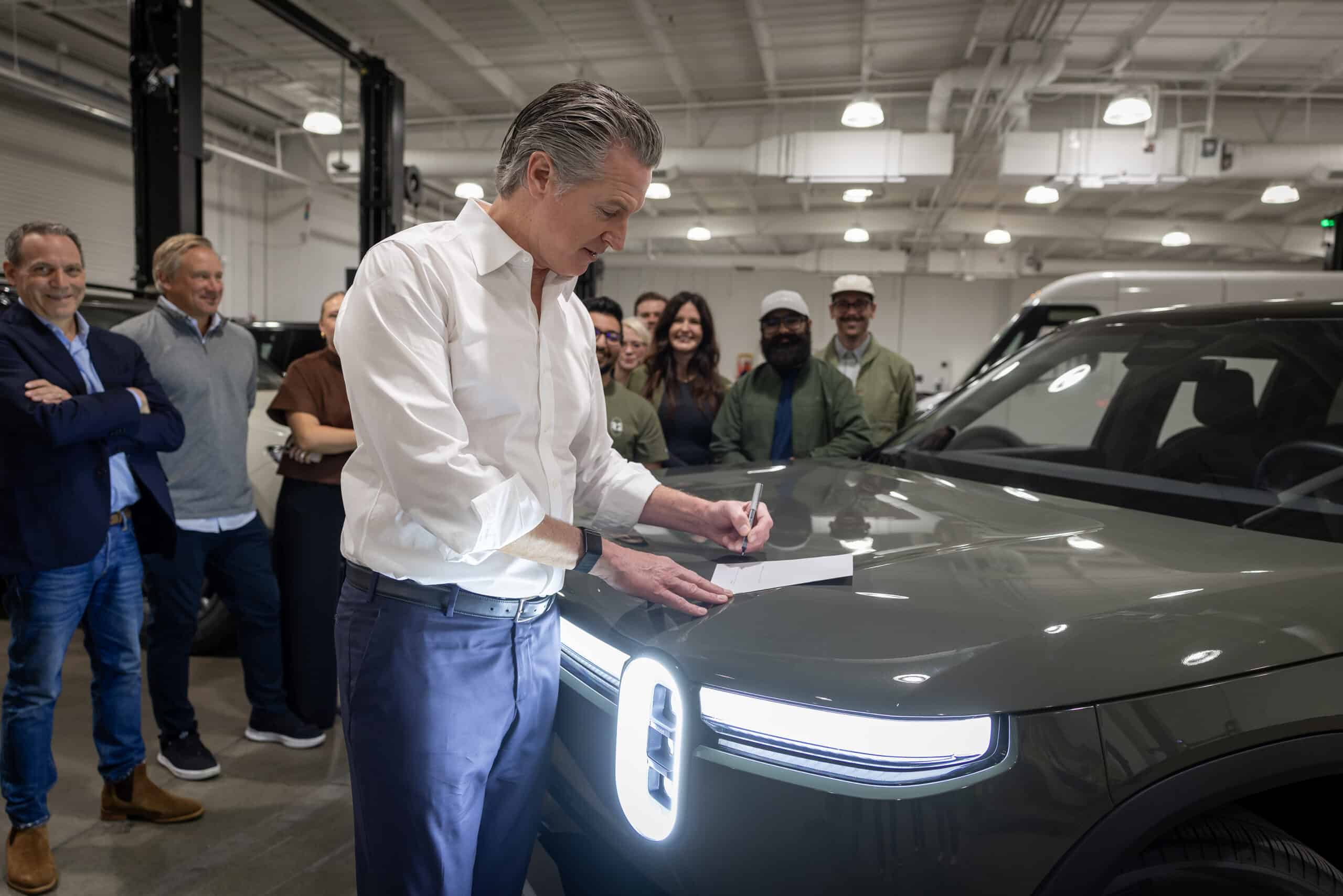
The timing is not incidental. Congress repealed the federal EV tax credit earlier this year, a decision that Democratic officials in California have cast as a strategic gift to Chinese automakers, who have raced ahead in electric vehicle production and battery technology while American manufacturers lose ground. Newsom, in a statement accompanying the bill signing, framed the state’s new investment as a direct response to what he described as a retreat by the Trump administration from the global clean car race.
How the rebate works
The new law, SB 168, sets aside $135.5 million in state funds, an amount that participating automakers are required to match dollar for dollar, bringing the total point-of-sale savings to $270 million. Buyers of new electric vehicles priced up to $50,000 will receive $3,500 off at the dealership, while buyers of used electric vehicles priced up to $25,000 will receive $1,750. The rebate is available to any Californian purchasing a zero-emission vehicle for the first time, regardless of income.
The instant nature of the discount is a deliberate design choice. Previous state and federal rebate programs required buyers to front the full cost of a vehicle and wait, sometimes for months, to be reimbursed, a structure that disadvantaged lower- and middle-income households without the cash on hand to cover the gap. By moving the subsidy to the point of sale, state officials say they are removing one of the most persistent barriers to EV adoption.
Part of a larger push
MyFirstEV is only one piece of the $600 million package, which state officials say is funded through revenue from California’s cap-and-invest program and smog-abatement fees rather than general tax dollars. The broader allocation includes $150 million for the Community Air Protection Program, $135.5 million for the state’s Clean Truck and Bus Voucher Incentive Project, $130 million to replace polluting heavy-duty engines through the Carl Moyer Program, $35 million for clean off-road equipment, and $19.8 million for lower-income Californians through the Clean Cars 4 All program.
State officials point to the funding package as evidence that California can expand climate investments while keeping its books balanced. The 2026-27 state budget that funds the program shows no deficit, a point Newsom’s office has emphasized amid broader scrutiny of the state’s fiscal management.
A market already ahead of the curve
California reached 2.5 million cumulative zero-emission vehicle sales in January, well past the 1.5 million goal the state had originally set for 2025. The state now counts more than 200,000 public and shared EV charging plugs, in addition to an estimated 800,000 chargers installed in private homes. Last September, San Bernardino County became home to the first hydrogen-powered passenger train in revenue service in North America, and the state has separately rolled out a $1 billion rebate program for electric trucks and $500 million for clean school buses.
state officials are betting that removing the wait for a rebate check will do what years of tax credits could not: turn hesitant shoppers into first-time EV owners at the moment they are standing on the dealership floor.