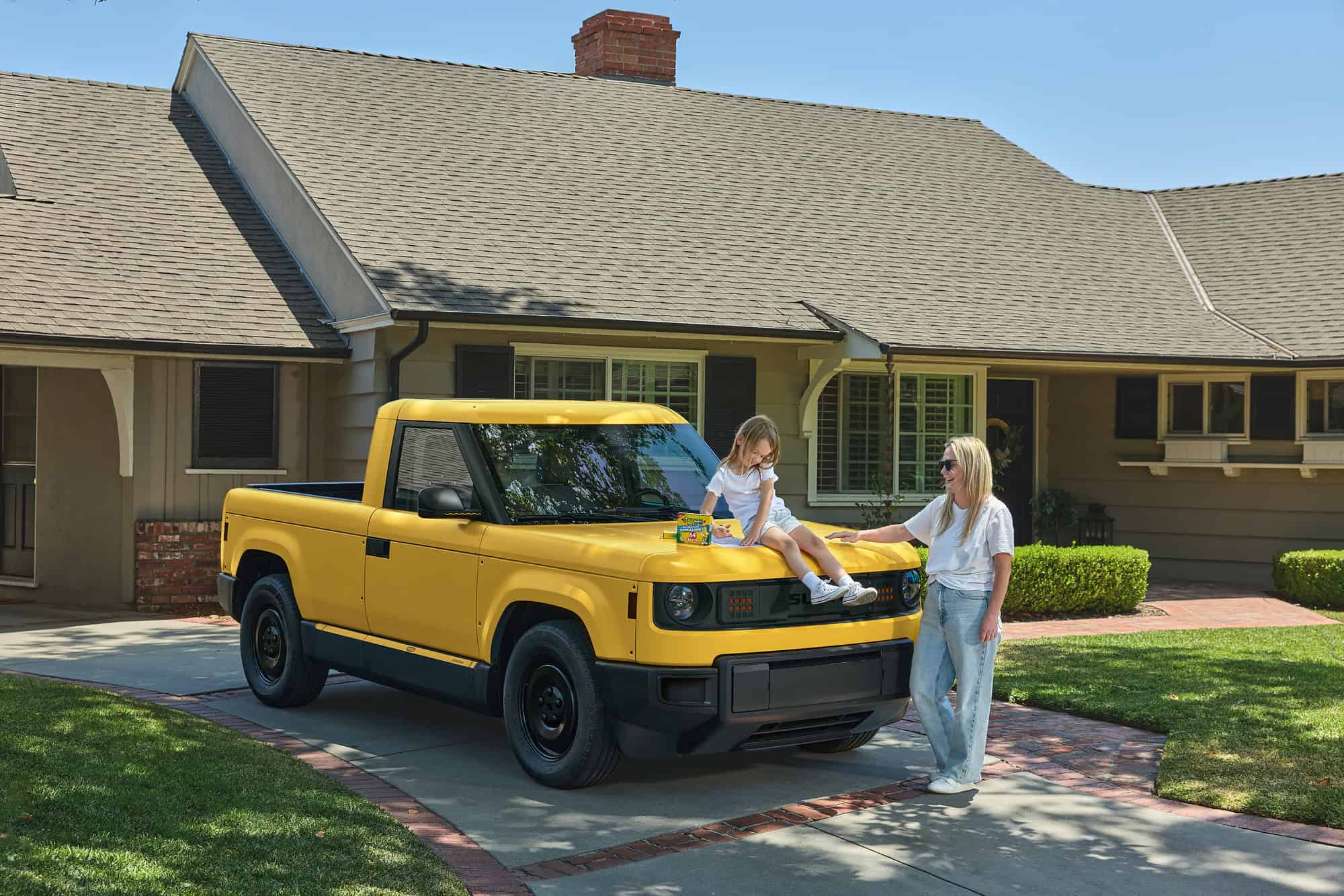
Slate announced Thursday that it is partnering with Crayola on a line of five vehicle wraps, pulling colors straight from the crayon box onto the sheet metal of the $24,950 Slate Truck — a price tag the company continues to market as the lowest of any new truck sold in America. The wraps come in Cerulean, Fern, Jersey Tomato, Razzmatazz, and Dandelion, the last of which Crayola describes as a fan favorite among its 120-plus shades.
It is Crayola’s first-ever automotive partnership, and it leans hard into the premise that made Slate’s launch strategy notable in the first place: these are trucks designed from the start to be wrapped, not painted, so an owner can peel off one identity and put on another without much more effort than reskinning a phone case.
A Blank Canvas, By Design
Slate’s whole manufacturing model is built around modularity. The trucks and its two SUV variants roll out of a reindustrialized factory in Warsaw, Indiana, in a bare-bones state, and owners add on from there — including converting a truck into an SUV after the fact. Vehicle wraps have been part of that customization pitch since the beginning, sold direct-to-consumer through the company’s online Slate Marketplace rather than through a traditional dealer network.
The Crayola tie-in formalizes that pitch into a starter pack: decals, a key fob cap, and a small clip-on dashboard accessory Slate calls a “Slatelet,” all themed to one of the five colors. Pricing starts at $1,549.99, and the packs go on sale at slate.auto/crayola ahead of customer deliveries, which the company still expects to begin in the fourth quarter of 2026.
“Slate vehicles are all about accessorization, and we collaborated with Crayola for their instantly recognizable palette as part of their first-ever automotive partnership,” said Ben Whitla, Slate’s head of brand and marketing, in the announcement. He framed the collaboration as two brands built around the same underlying value — letting people put a personal stamp on something mass-produced.
Crayola’s Anna Roca, head of global partnerships, echoed that framing from the other side of the deal. “Color has always been a powerful form of self-expression,” she said, describing the partnership as a way to turn “a vehicle into a canvas” using colors many customers have known since childhood.
The Reservation Comes First
Buying into the Crayola line doesn’t require committing to a color, or even a body style, up front. Slate’s $300 preorder reserves a build slot without locking in a configuration, and the company says customers can add a Crayola starter pack any time before delivery — a sequencing choice that fits Slate’s broader argument that the base vehicle is a starting point, not a finished product.
That argument has been central to how Slate has positioned itself since the company was founded in 2022: a stripped-down, safety-focused vehicle at a price point well below the rest of the new-truck market, with the expectation that owners will spend on the accessories that matter to them rather than paying for options they don’t want baked into the sticker price.
Whether five crayon-inspired wraps move the needle on preorders is a separate question from whether the idea works as marketing. Pairing an industrial product — sheet metal, a modular chassis, a factory in Indiana — with a brand whose entire identity is tactile, childhood creativity is an unusual combination for the auto industry, which more often reaches for performance partners or lifestyle brands aimed squarely at adults. Crayola’s audience skews toward parents and educators as much as it does drivers, and the wraps are as much a bet on nostalgia as they are on color theory.
For Slate, though, the collaboration is less about who buys a Dandelion-wrapped truck and more about reinforcing the idea that a Slate is never really finished. The company has said it wants customers cycling through different looks over the life of the vehicle, not choosing once at the dealership and living with it. A crayon box, as a metaphor, does that work for free.