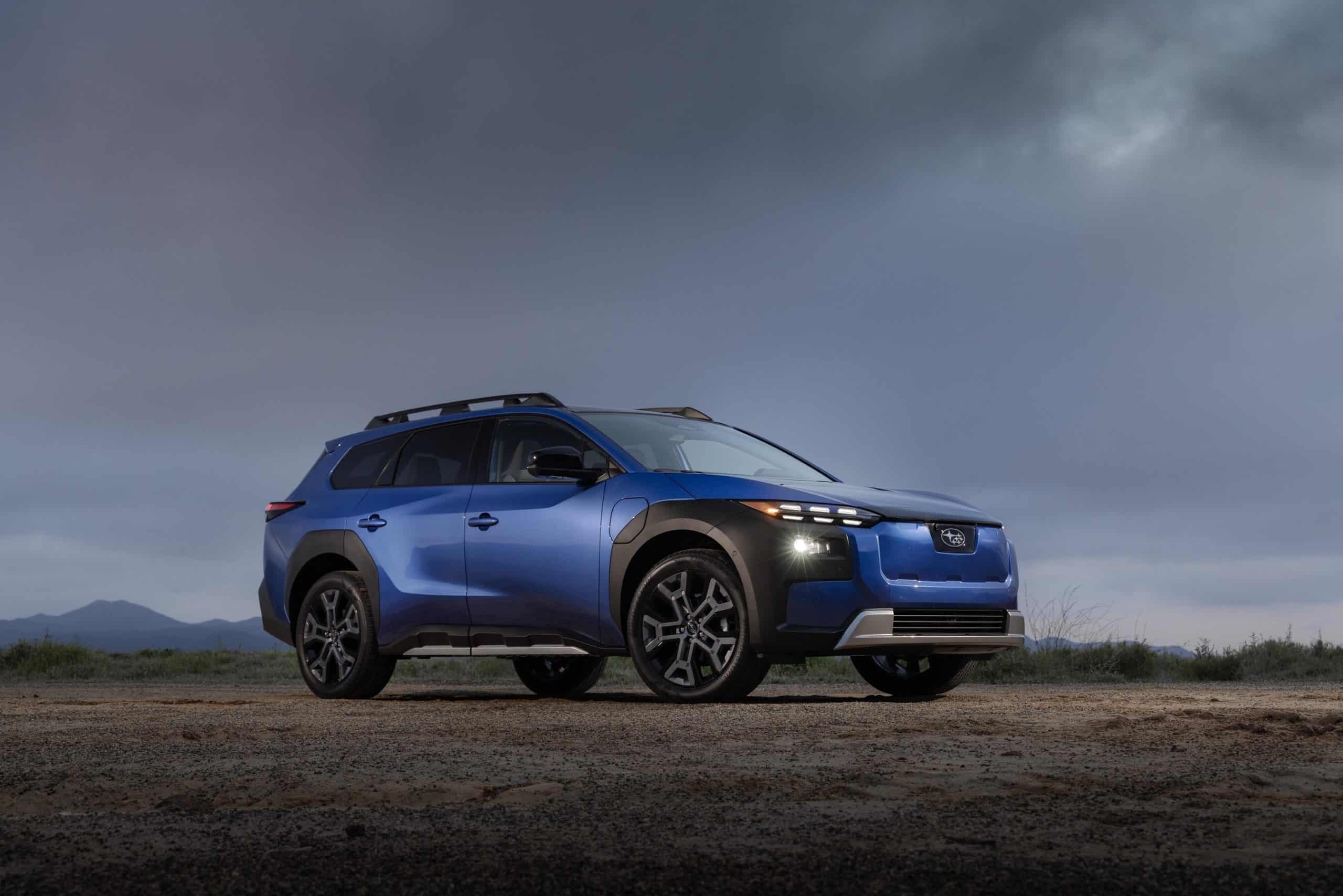
Subaru reports its all-new 2027 Trailseeker will arrive this fall with a starting price of $39,995—the same MSRP as the outgoing model. At a time when many manufacturers continue to grapple with the economics of electrification, maintaining pricing while substantially upgrading performance sends a clear message: Subaru believes value has become one of the most important features an EV can offer.
The Trailseeker also reflects Subaru’s effort to answer a question that has lingered over the industry’s transition to electric power: Can an EV still feel like a Subaru?
For decades, the brand has built its reputation around practical all-wheel-drive vehicles capable of venturing beyond paved roads. The Trailseeker attempts to carry that identity into the electric era without abandoning the characteristics that have defined the company.
Standard Symmetrical All-Wheel Drive remains central to the vehicle’s design, but engineers have reworked the system for an electric powertrain. The dual-motor setup continuously manages power distribution between the front and rear axles while coordinating regenerative braking to improve traction on snow, gravel, mud and changing pavement conditions.
The numbers are striking.
With 375 horsepower, the Trailseeker accelerates from zero to 60 miles per hour in just 4.3 seconds, making it the quickest production Subaru ever sold in the United States. Yet outright speed is not the vehicle’s primary story. Subaru pairs that performance with 8.5 inches of ground clearance, X-MODE off-road drive modes, hill descent control and the ability to tow up to 3,500 pounds—specifications aimed squarely at customers who spend weekends hauling camping gear, bikes or small trailers.
Range, meanwhile, lands in the increasingly competitive middle of today’s EV market.
Powered by a 74.7-kilowatt-hour lithium-ion battery, the Trailseeker delivers up to 281 miles of EPA-estimated driving range, depending on trim. While it doesn’t chase the industry’s highest range figures, Subaru appears to have prioritized a balance between battery size, cost and real-world usability.
Charging convenience may prove just as important.
The Trailseeker adopts the North American Charging Standard (NACS), giving owners direct access to more than 25,000 compatible DC fast-charging stations across North America without relying on proprietary adapters. Under ideal conditions,
the battery can recharge from 10% to 80% in approximately 28 minutes using a 150-kilowatt DC fast charger. Battery preconditioning also allows the vehicle to maintain faster charging speeds in temperatures as low as 14 degrees Fahrenheit, addressing one of the more persistent frustrations of cold-weather EV ownership.
Inside, Subaru has noticeably modernized the cabin without abandoning its reputation for practicality.
A standard 14-inch touchscreen anchors the dashboard, while wireless Apple CarPlay and Android Auto come standard across the lineup. Dual wireless phone chargers, heated front seats and Subaru’s EyeSight driver-assistance technologies are included even on the entry-level Premium trim. Higher trims add features that have become increasingly common in upper-tier EVs, including a panoramic glass roof, ventilated front seats, premium Harman Kardon audio, digital key functionality and panoramic camera systems.
Cargo remains another priority.
The Trailseeker offers more than 31 cubic feet of rear cargo space—roughly comparable to the gasoline-powered Outback—and roof rails capable of supporting a 700-pound static load, making rooftop tents and outdoor equipment part of the vehicle’s intended lifestyle rather than an afterthought.
The new model also grows meaningfully compared with Subaru’s existing electric offering, the Solterra. It is more than six inches longer and nearly an inch taller, creating additional passenger room while preserving the upright proportions familiar to Subaru buyers.
Perhaps the most significant aspect of the Trailseeker, however, is what it says about Subaru’s broader strategy.
Rather than pursuing the luxury end of the EV market or engaging in a specification race over maximum driving range, Subaru appears focused on serving its traditional customer base—buyers who value capability, dependability and year-round confidence more than headline-grabbing technology.
Pricing reinforces that approach.
The Premium model starts at $39,995, followed by the Limited at $43,995 and the Touring at $46,555 before destination charges. Even the fully equipped Touring remains below many similarly equipped electric SUVs now entering the market.
For buyers who have waited for an electric Subaru that feels unmistakably like a Subaru, the Trailseeker may represent the company’s most convincing answer yet.