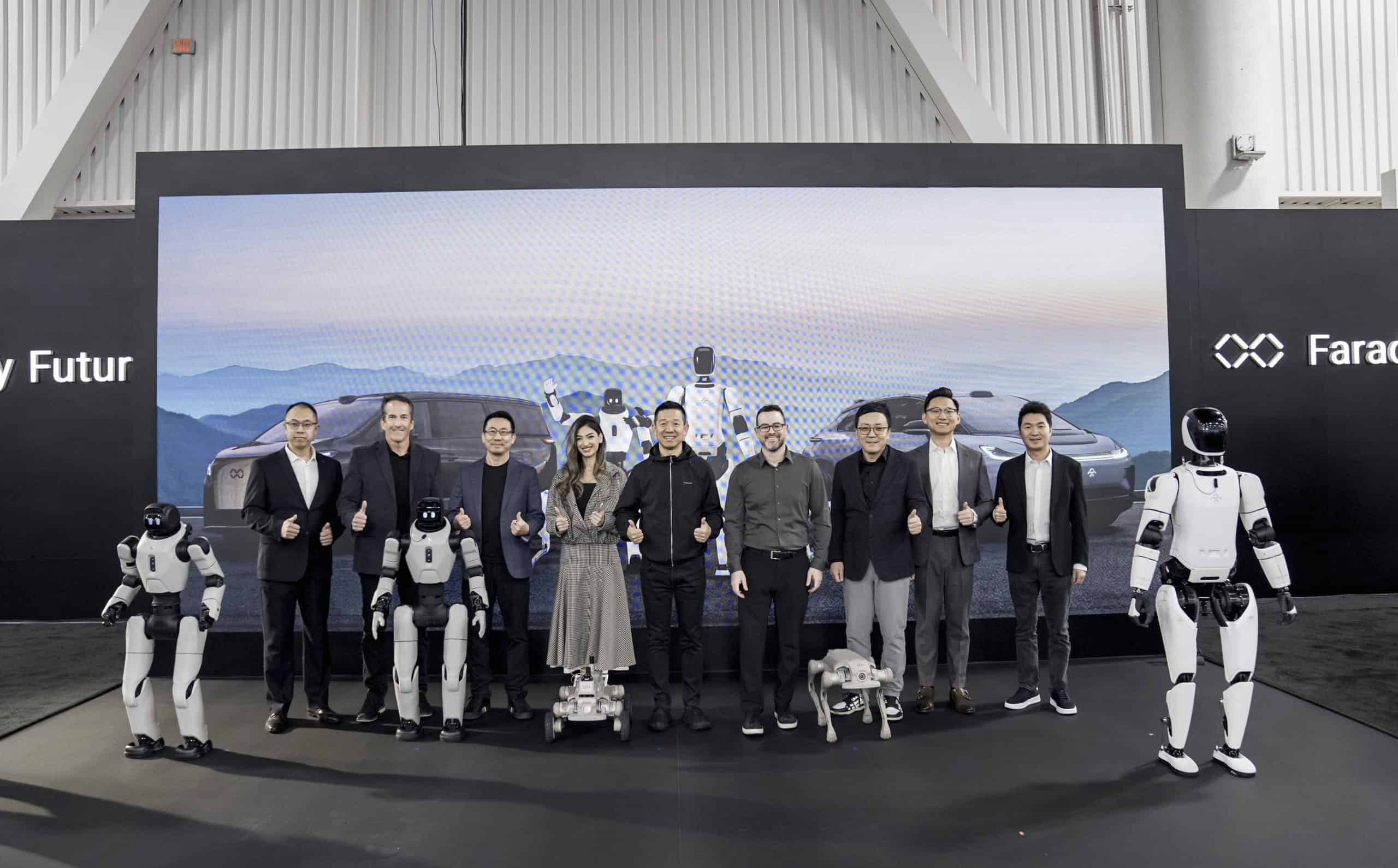
Faraday Future, the electric-vehicle is once again asking investors, partners and the public to look ahead rather than back.
On Tuesday, at the annual National Automobile Dealers Association conference here, the California-based company announced the launch of a new subsidiary, FF EAI-Robotics Inc., and unveiled three artificial intelligence–driven robots — two humanoids and one quadruped — marking an ambitious expansion beyond automobiles and into the fast-moving world of embodied artificial intelligence.
The company said it plans to begin deliveries of its first robots by the end of February, positioning itself, it claims, as the first U.S.-based company to deliver both humanoid and quadruped robots simultaneously.
The debut included the FF Futurist, a full-size humanoid robot designed for professional environments; the FF Master, a more athletic, consumer-oriented humanoid; and FX Aegis, a four-legged robot aimed at security, inspection and companionship roles. Prices range from $2,499 for the quadruped to nearly $35,000 for the flagship humanoid.
Faraday Future also introduced what it calls a “three-in-one” robotics ecosystem, combining hardware devices, an open-source AI “brain,” and a decentralized data platform — an approach the company says will allow its robots to improve continuously through real-world deployment.
For Faraday Future, whose electric vehicles remain rare on American roads more than a decade after the company’s founding, the robotics announcement represents both a pivot and a doubling down on its original thesis: that vehicles — and now machines more broadly — should be treated as intelligent, evolving platforms rather than static products.
“This is a pivotal moment,” said YT Jia, Faraday Future’s founder and global co-chief executive, in a statement. “Embodied AI robots working alongside humans will help reshape productivity models through human–machine symbiosis.”
A Second Act for a Troubled Automaker
The move into robotics comes as Faraday Future continues to search for stability after years of financial strain, production delays and leadership controversies.
Founded in 2014 with bold promises to challenge Tesla and redefine electric mobility, Faraday quickly became one of Silicon Valley’s most closely watched startups. Flush with early capital and eye-catching design concepts, the company broke ground on a massive factory in Nevada that was never completed and teased vehicles that remained largely theoretical for years.
Its flagship electric vehicle, the FF 91, was finally delivered to its first customer in 2023 — nearly six years later than originally promised — and in extremely limited numbers. Regulatory filings have repeatedly raised questions about the company’s ability to continue as a going concern, and Faraday has relied on a steady stream of new financing, restructurings and strategic resets to stay afloat.
Critics have long argued that the company’s core challenge is not vision but execution. “Faraday has consistently announced grand strategies without demonstrating sustained manufacturing scale,” said one auto industry analyst who requested anonymity because of ongoing business relationships. “Robotics may be exciting, but it also risks being another distraction from the hard work of building and selling cars.”
Others note that the robotics market itself is far from proven. While companies like Boston Dynamics, Tesla and a wave of Chinese startups have demonstrated impressive prototypes, large-scale commercial adoption of humanoid robots remains limited, and profitability elusive.
Still, Faraday executives argue that robotics offers advantages that automobiles do not: lower regulatory barriers, faster product cycles and, potentially, quicker paths to positive cash flow.
Robots Built for the Real World
The company’s flagship humanoid, the FF Futurist, is positioned as a professional-grade machine designed for hotels, retail spaces, museums, schools and industrial settings. Powered by Nvidia’s Orin computing platform, it offers up to 200 trillion operations per second of processing capability and is equipped with cameras, lidar, tactile sensors and 5G connectivity.
The robot has 28 motors, can operate for up to three hours on a hot-swappable battery and supports interaction in up to 50 languages. Faraday says its facial display and software can be customized for different roles, from concierge to sales associate to laboratory assistant.
The FF Master, priced lower and aimed at home and educational use, is designed as a more agile, adaptive companion robot with 30 degrees of freedom. The company envisions it assisting with learning, monitoring homes remotely and evolving into roles such as personal trainer or research assistant.
The FX Aegis quadruped, the least expensive of the trio, is designed for security, patrol and inspection tasks. It can climb steep slopes, navigate uneven terrain and be outfitted with add-ons ranging from cameras to robotic arms and fire extinguishers. Faraday says it can operate autonomously or via remote control, even in environments with limited connectivity.
The company reported more than 1,200 paid, nonbinding business-to-business deposits across its robotics lineup, though it acknowledged that some consumer preorders were made by partners participating in compensated co-creation programs.
A Bet on Ecosystems, Not Just Hardware
Central to Faraday’s pitch is the idea that robots, like vehicles, should be platforms — continuously updated through over-the-air software, data sharing and modular hardware upgrades.
The company says its robotics and vehicle businesses will function as “twin engines,” sharing research, manufacturing processes and sales channels. It is also seeking to integrate robot sales into its dealer-partner model, arguing that future car dealerships could evolve into “intelligent terminal operators” selling both vehicles and machines.
That vision aligns with broader industry trends. Advances in large language models, battery technology and AI computing have lowered barriers to entry in robotics, while labor shortages in logistics, security and caregiving have created new demand.
“Robotics is reaching a tipping point,” said Jon Rettinger, a technology creator who attended the event. “The breakthroughs are real — the question now is who can commercialize them at scale.”