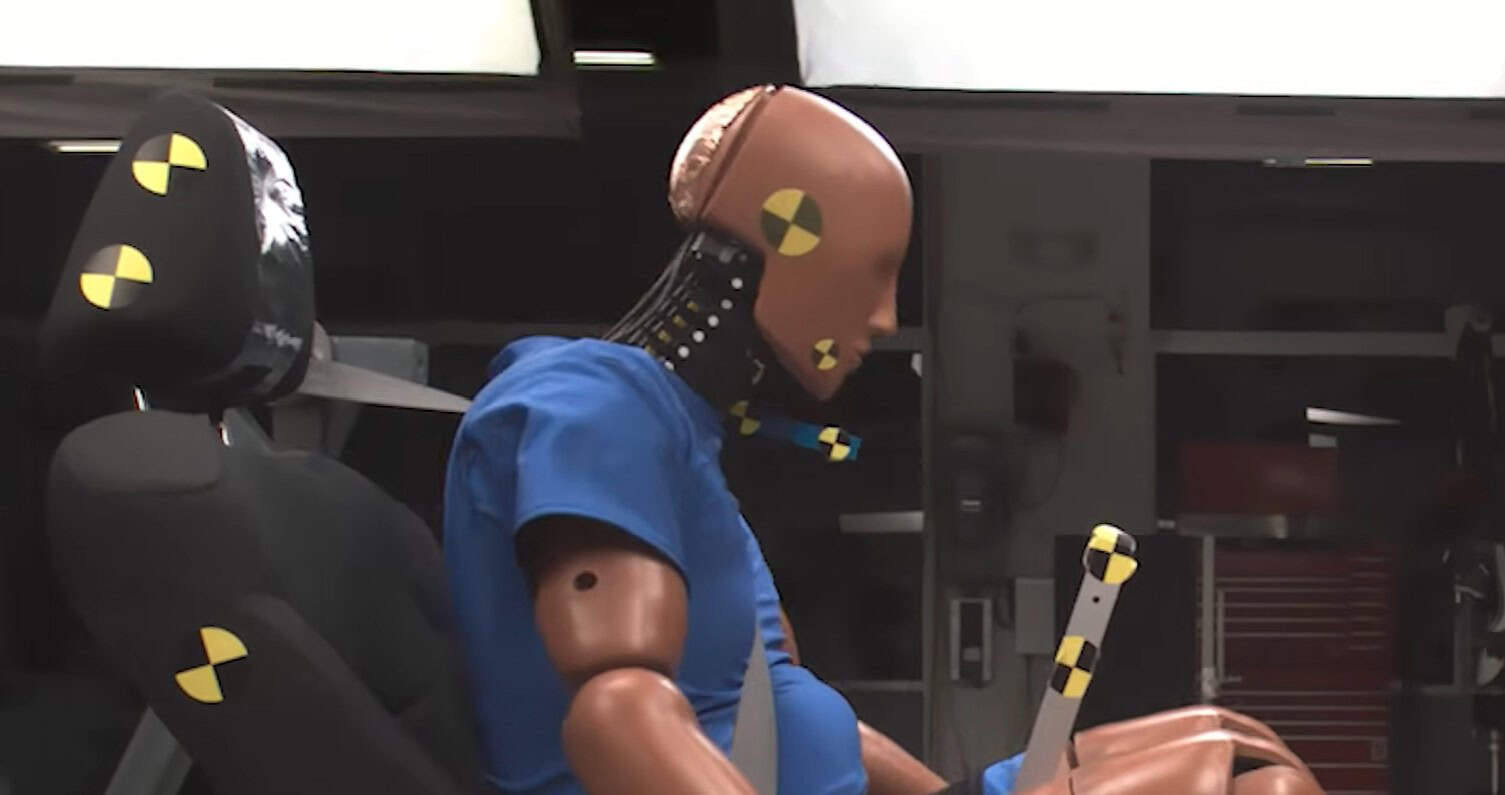
On Tuesday, the Insurance Institute for Highway Safety (IIHS) unveiled a rigorous new testing program designed to address this lingering vulnerability. The initial results were sobering: of 18 small S.U.V.s subjected to the new protocol, only four earned the top rating of “Good.”
The findings suggest that while modern cars are better than ever at preventing death, they are still struggling to protect the delicate architecture of the human neck during the mundane reality of a rear-end shunt.
A Higher Bar for the Headrest
Whiplash, a soft-tissue injury caused by the rapid back-and-forth jerking of the head, accounts for the highest volume of U.S. auto insurance claims. For years, the IIHS. utilized a 20-mph sled test that eventually became so easy to pass that nearly every vehicle on the market received a top score.
“That evaluation was discontinued because automakers had improved their designs so that virtually all the vehicles tested now earned good ratings,” said David Harkey, the president of the IIHS. “But occupants were still suffering from whiplash injuries.”
The new test increases the stakes, utilizing a specialized dummy with a sophisticated, articulated spine. It subjects seats to two separate “pulses”—simulating impacts at both 20 mph and 30 mph—while measuring how well the seat absorbs energy and keeps the head and spine in alignment.
The Honor Roll and the Failures
The top performers in this first round included the Audi Q3, the Hyundai Ioniq 5, the Subaru Forester, and the Toyota RAV4. In these vehicles, sensors and video footage showed the head restraints catching the occupant’s head quickly, maintaining the natural curve of the cervical spine.
At the other end of the spectrum, three popular models—the Ford Bronco Sport, the Hyundai Tucson, and the Mazda CX-50—received “Poor” ratings. In these instances, the disconnect between the seat’s movement and the dummy’s torso was stark. In the Mazda, the head was allowed to slide backward and upward; in the Hyundai, the headrest pushed the chin down toward the chest, a movement known to exacerbate injury.
Nine other models, including the Honda CR-V and the Volvo XC40, were deemed “Acceptable,” while the BMW X1 and Nissan Rogue were rated “Marginal.”
The Physics of Comfort
The challenge for engineers lies in the physics of the seat itself. Ideally, when a car is struck from behind, the occupant should sink into the seatback, allowing the pelvis and torso to move in tandem with the head. If the seat is too rigid, or the headrest too far back, the spine is forced into a shape that stretches and straightens the vertebrae—the mechanical precursor to chronic pain.
“We don’t yet fully understand the mechanisms that cause whiplash injuries,” said Marcy Edwards, a senior research engineer at the institute. “But our research makes us confident that reducing these types of movements and stresses should cut down on whiplash injuries in the real world.”
Whiplash prevention ratings for 18 small SUVs
| Vehicle | Rating |
|---|---|
| 2025 Audi Q3 | G |
| 2025-26 Hyundai Ioniq 5 | G |
| 2025-26 Subaru Forester | G |
| 2025 Toyota RAV4 | G |
| 2025-26 Buick Encore GX | A |
| 2025-26 Chevrolet Equinox | A |
| 2024-25 Honda CR-V | A |
| 2025-26 Jeep Compass | A |
| 2025-26 Kia Sportage | A |
| 2025 Mercedes-Benz GLB-Class | A |
| 2025-26 Mitsubishi Outlander | A |
| 2025-26 Volkswagen Taos | A |
| 2025-26 Volvo XC40 | A |
| 2025 BMW X1 | M |
| 2025-26 Nissan Rogue | M |
| 2025-26 Ford Bronco Sport | P |
| 2025-26 Hyundai Tucson | P |
| 2025-26 Mazda CX-50 | P |
Key