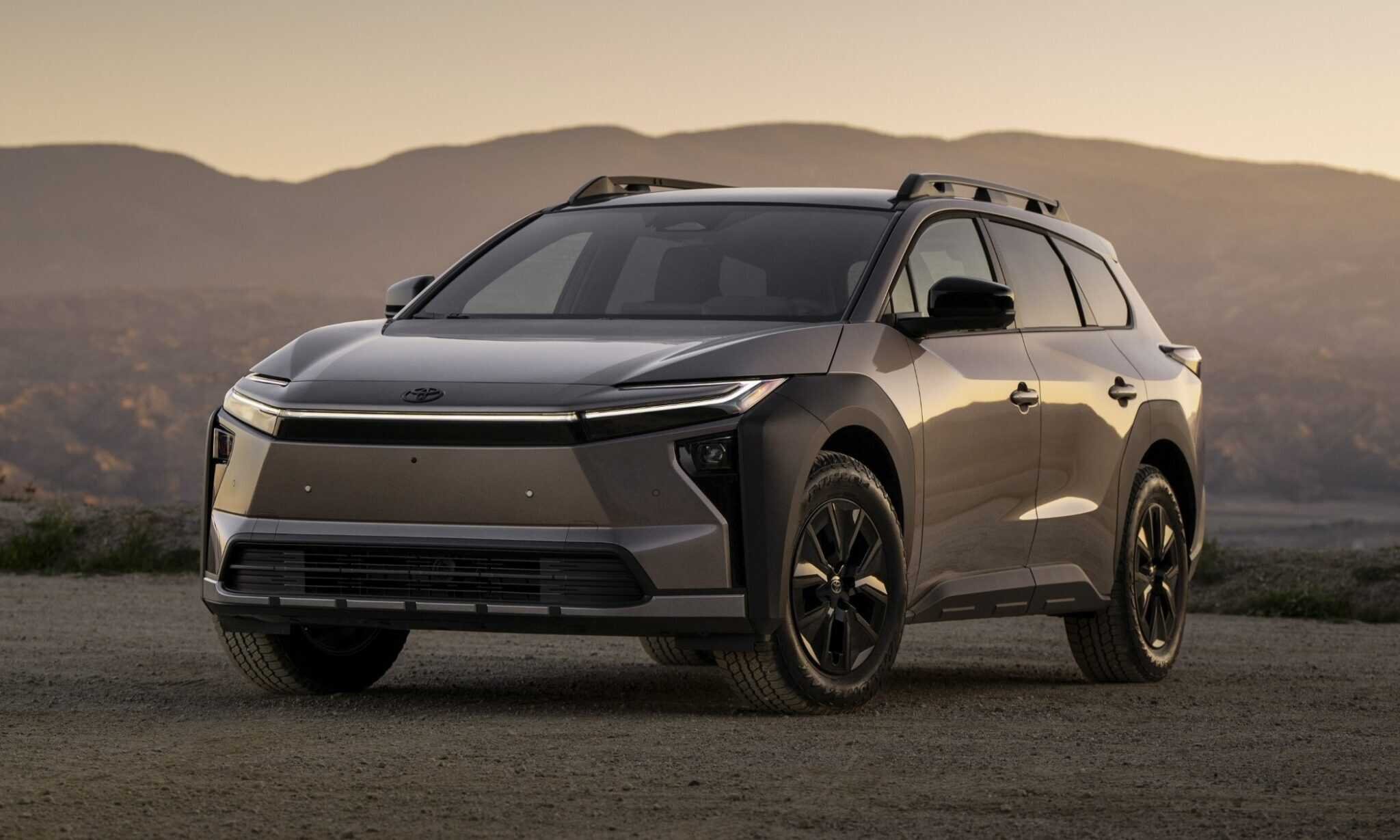
With standard dual-motor all-wheel drive and a muscular 375 horsepower, the bZ Woodland is not merely a cosmetic variation on Toyota’s existing bZ SUV. It is, at least by the company’s measure, the most powerful model in the bZ family so far, capable of accelerating from 0 to 60 miles per hour in an estimated 4.4 seconds. Its projected driving range tops out at 281 miles, according to the Environmental Protection Agency, though that figure dips to 260 miles when equipped with optional all-terrain tires.
A More Rugged Silhouette
The Woodland edition distinguishes itself visually and dimensionally from its sibling. Black overfenders accent Toyota’s so-called “hammerhead” front fascia, giving the SUV a more outdoors-oriented stance. The body stretches nearly six inches longer than the standard bZ and stands slightly taller at the rear, yielding an increase in cargo capacity — 74.3 cubic feet with the second row folded flat, compared with 67.1 cubic feet in the conventional model.
Ground clearance measures 8.4 inches, and the Woodland can tow up to 3,500 pounds, figures that place it squarely in midsize SUV territory. Standard roof rails and 18-inch aluminum wheels with aerodynamic covers add to its dual-purpose character: urban commuter during the week, trailhead companion on weekends. For drivers inclined toward dirt roads and snowbound passes, all-terrain tires are available, albeit at the cost of some range.
Electric Power, Tuned for the Trail
Beneath the sheet metal lies Toyota’s dedicated e-TNGA battery-electric platform, housing a 74.7-kilowatt-hour lithium-ion battery mounted low in the chassis. That placement lowers the center of gravity and enhances rigidity through a cross-framing structure integrated into the battery pack — engineering choices intended to offset the heft typical of electric SUVs.
The Woodland’s all-wheel-drive system employs electric motors at both axles and includes X-MODE, Toyota’s traction-management software designed to optimize brake control and power delivery on slippery or uneven surfaces. A low-speed Grip Control function modulates torque to maintain steady progress in adverse conditions, freeing the driver to focus on steering rather than throttle inputs.
Like most electric vehicles, the Woodland pairs its brisk acceleration with near-silent operation. Steering-wheel-mounted paddles allow drivers to adjust regenerative braking intensity, capturing kinetic energy during deceleration and returning it to the battery.
Charging for a Broader Network
The 2026 Woodland adopts the North American Charging System (NACS) port, aligning it with the connector design popularized by Tesla and increasingly embraced by other automakers. Under ideal conditions, Toyota estimates the battery can replenish from 10 percent to 80 percent in roughly 30 minutes using a Level 3 DC fast charger.
A battery pre-conditioning system — manually activated or triggered automatically when navigating to a fast-charging station — prepares the pack for optimal charging temperatures. Plug & Charge capability streamlines authentication at participating networks, reducing reliance on multiple smartphone applications.
At home, the Woodland supports both Level 1 and Level 2 charging through an 11-kilowatt onboard charger and includes a dual-voltage 120-volt/240-volt cable.
Two Grades, Generous Equipment
The Woodland will be offered in two trims: a base model and a Premium grade. Both feature a 14-inch touchscreen running Toyota Audio Multimedia, dual wireless charging pads, heated front seats and heated outboard rear seats, a heated steering wheel, and dual-zone automatic climate control. SofTex-trimmed seating and customizable ambient lighting round out the interior.
The Premium version layers on ventilated front seats, radiant foot and leg heaters, driver-seat memory, a panoramic fixed-glass roof with power sunshade, and a nine-speaker JBL audio system with subwoofer and 800-watt amplifier. A digital rearview mirror and upgraded exterior mirrors with memory settings underscore its near-luxury aspirations.
Connectivity features include wireless Apple CarPlay and Android Auto compatibility, dual Bluetooth phone pairing, and available Wi-Fi capability that can support up to five devices. Toyota’s suite of connected services — including cloud-based navigation, voice-activated Intelligent Assistant, and remote climate and charging controls via smartphone — is bundled with trial subscriptions.
Expanding an Electrified Portfolio
The Woodland arrives as Toyota continues to balance its long-standing hybrid leadership with a measured expansion into fully electric models. It will join a refreshed bZ SUV and the all-new C-HR electric crossover, bringing the automaker’s total number of electrified offerings — including hybrids, plug-in hybrids and fuel-cell vehicles — to 21 models in North America.
Safety technology remains a central selling point. Toyota Safety Sense 3.0 comes standard, incorporating features such as a pre-collision system with pedestrian detection, adaptive cruise control, lane-keeping assistance and road-sign recognition. Blind Spot Monitoring with Rear Cross-Traffic Alert, a panoramic view monitor and Safe Exit Alert are also included.
The Woodland carries Toyota’s standard warranty coverage: three years or 36,000 miles for basic components, five years or 60,000 miles for the powertrain, and eight years or 100,000 miles for electric-vehicle driving components, including the traction battery. ToyotaCare adds two years of scheduled maintenance and three years of roadside assistance.
For Toyota, whose reputation in North America was built on durability and hybrid efficiency, the bZ Woodland represents a subtle recalibration. It signals an effort to marry the environmental imperatives of electrification with the American appetite for utility vehicles that promise adventure, even if that adventure often unfolds in suburban driveways.
Whether the Woodland becomes a breakout success may depend less on its 375 horsepower than on how seamlessly it integrates into a charging ecosystem still in transition. But in a market increasingly defined by electric crossovers, Toyota is making clear that its battery-powered future will not be confined to paved roads alone.