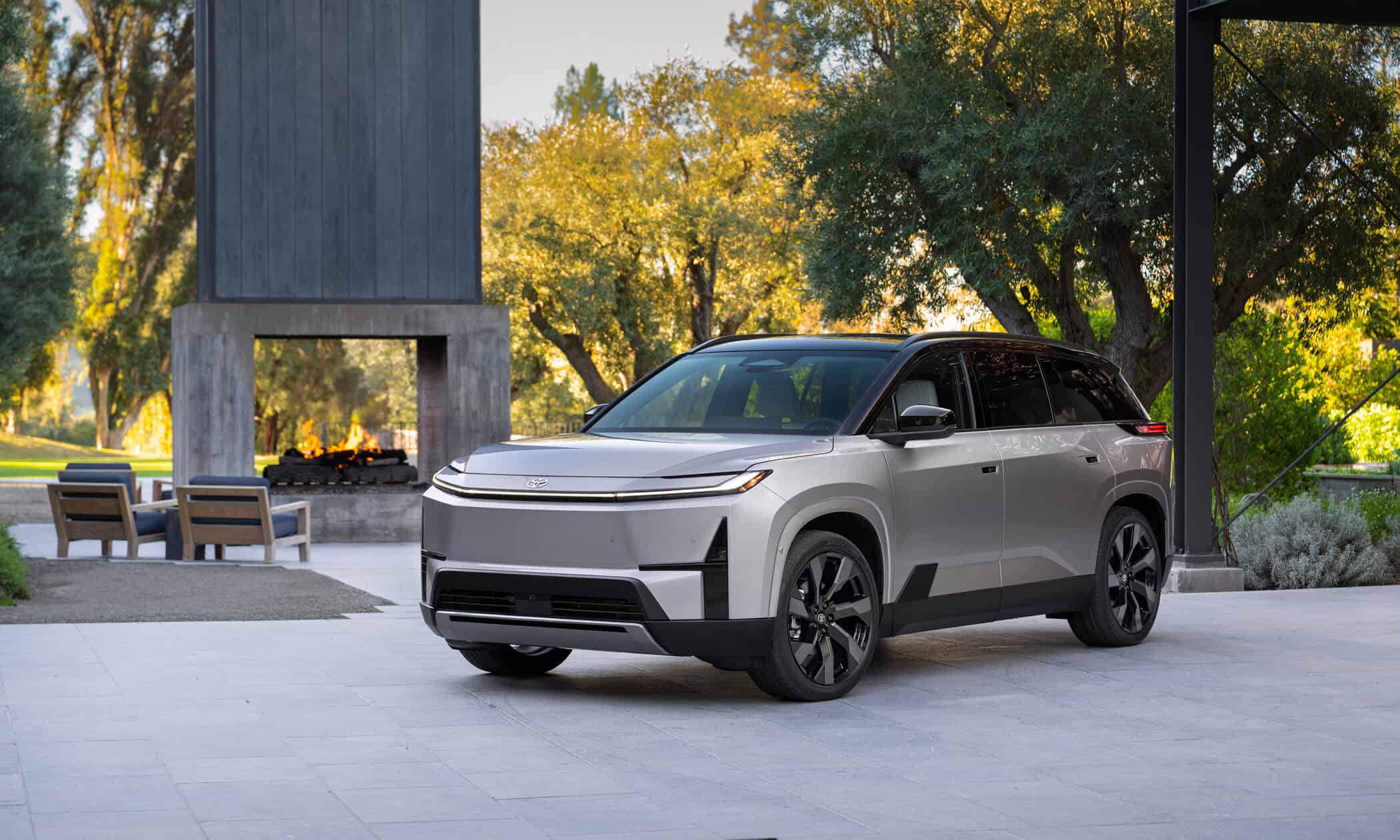
For 2027, the three-row family SUV Toyota Highlander is a battery-electric vehicle and the first three-row electric model in the company’s American portfolio.
The shift is not merely mechanical. Toyota has reimagined the Highlander in form and function, lowering its roofline, widening its stance and reshaping its proportions to signal a break from the past. The result is an SUV that appears sleeker and more planted, with slim, full-width LED daytime running lights and flush door handles that lend it a faintly futuristic air. Inside, a 14-inch central touchscreen and a 12.3-inch digital gauge cluster dominate a cabin designed to feel both open and technologically current.
The new Highlander will be assembled in Georgetown, Ky., at Toyota Motor Manufacturing Kentucky, making it the automaker’s first battery-electric vehicle built in the United States. Its battery modules will come from Toyota’s newly opened $13.9 billion battery plant in Liberty, N.C., underscoring the company’s effort to root its electric transition in domestic production.
David Christ, Toyota’s group vice president of marketing, described the vehicle as a “stylish, high-tech leader” in the midsize SUV segment — a segment long defined by practicality rather than spectacle. Yet the company is clearly aiming to marry everyday utility with the performance attributes that have come to define modern electric vehicles: instant torque, low centers of gravity and near-silent propulsion.
The 2027 Highlander will be offered in two grades, XLE and Limited, with a choice of front- or all-wheel drive in certain configurations. Battery options range from 77.0 kilowatt-hours to 95.8 kilowatt-hours. In its most capable form — the all-wheel-drive XLE or Limited equipped with the larger battery — Toyota estimates a driving range of up to 320 miles. Front-wheel-drive XLE models with the smaller battery are expected to deliver an estimated 287 miles.
Performance varies accordingly. All-wheel-drive versions produce up to 338 combined system horsepower and 323 pound-feet of torque, figures that place the Highlander squarely in competitive territory among three-row electric SUVs. Front-wheel-drive models generate 221 horsepower.
Toyota has fitted the Highlander with a North American Charging System (NACS) port, granting access to a broad and growing network of DC fast-charging stations. Under ideal conditions, the battery can charge from 10 percent to 80 percent in roughly 30 minutes. A battery preconditioning system — manually activated or triggered through the navigation system when routing to a fast charger — is intended to optimize charging speed in colder conditions.
Inside, the Highlander retains its family-first orientation. Seating for up to seven is available, with second-row captain’s chairs standard and a bench seat optional on certain all-wheel-drive XLE models. SofTex-trimmed seats, heated front seats and a heated steering wheel are standard; ventilated front seats and heated second-row seats are offered on the Limited. With the third row folded flat, cargo capacity exceeds 45 cubic feet.
Toyota has also leaned into connectivity and digital services. The latest Toyota Audio Multimedia system, developed in North America, features 5G connectivity, wireless Apple CarPlay and Android Auto, and enhanced voice commands activated by “Hey Toyota.” A built-in drive recorder uses exterior cameras to capture short clips of driving events. Standard Toyota Safety Sense 4.0 includes updated driver-assistance features such as pre-collision braking with pedestrian detection, lane tracing assist and adaptive cruise control.
One of the more novel additions is vehicle-to-load capability, which allows the Highlander to power external devices — from campsite appliances to emergency home equipment — through bi-directional accessories. In a market increasingly attentive to resilience amid extreme weather, the ability to serve as a backup power source may prove more than a novelty.
The Highlander enters its fifth generation at a moment of transition not only for Toyota but for the broader industry. For years, the automaker championed hybrids as a pragmatic bridge to electrification. Now, as regulatory pressures mount and consumer expectations shift, Toyota is expanding its battery-electric lineup. The Highlander joins the bZ, bZ Woodland and C-HR as the fourth BEV in the brand’s U.S. portfolio.
Yet the Highlander carries symbolic weight beyond its specifications. Introduced in 2000 as one of the first car-based midsize SUVs, it helped normalize the unibody crossover at a time when truck-based sport-utility vehicles dominated American roads. A hybrid version followed in 2005, positioning Toyota early in the electrification movement.
With the 2027 model, Toyota again stakes out a new chapter — this time in full electrification. Sales are expected to begin in late 2026, with pricing to be announced closer to launch.
The Highlander that once borrowed heavily from the Camry’s architecture now draws instead from battery modules assembled in North Carolina and software shaped by 5G connectivity.
The 2027 Highlander will be offered in two trim levels, XLE and Limited, each equipped with a broad array of technology and comfort features. Even the XLE arrives well appointed, with full-width LED daytime running lights, acoustic front glass, 19-inch wheels, semi-flush electronic door handles and a 14-inch touchscreen paired with a 12.3-inch digital instrument cluster. Heated front seats and steering wheel, SofTex-trimmed upholstery, 64-color ambient lighting and a one-touch folding second row underscore its family-friendly focus, while regenerative braking paddle shifters, an 11-kW onboard charger and a standard NACS charging port reflect its electric underpinnings. Toyota Safety Sense 4.0 and a built-in drive recorder are also standard.
The Limited builds on that foundation with additional refinement and driver-assistance technology, including a head-up display, ventilated front seats, heated second-row seats, memory side mirrors, rear sunshades and a suite of advanced parking and traffic-assist features such as Advanced Park, Traffic Jam Assist, Lane Change Assist and a Panoramic View Monitor.
Select options across the lineup include a panoramic glass roof, a JBL premium audio system, available bench seating in certain XLE all-wheel-drive models and, on the Limited, two-tone paint and 22-inch wheels.